• Rethinking Rural Health Financing: Investment Opportunities and Challenges (Bonus Episode)
    Jan 31 2026

    Why does rural health remain underfunded - even when everyone agrees it matters?

    In this opening monologue of Rethinking Rural Health Financing, Chinasa Imo sets the stage for a bold new podcast series that interrogates one of the most overlooked drivers of health inequity: how money moves, who controls it, and who is left out.

    This episode challenges the assumption that rural health struggles are simply about distance, infrastructure, or workforce shortages. Instead, it asks harder questions about power, priorities, and financing decisions that consistently place rural communities at the margins of health systems.

    From under-resourced clinics and unpaid health workers to donor dependency, political neglect, and the hidden costs rural families shoulder just to access “free” care, this monologue reframes rural health as a financing design problem, not a service delivery failure.
    This series will explore:
    Why rural health is chronically underfunded
    How financing models exclude rural populations
    The role of governments, donors, and private investment
    Why rural communities pay the most for the least care
    What equitable, dignity-centred rural health financing could look like

    Rethinking Rural Health Financing is not about easy answers. It’s about asking the questions we avoid - and centring rural lives in global health conversations where they are too often invisible. Listen, reflect, and join the conversation.

    Want to be a guest on What About Rural Health?™? Send Chinasa Imo a message on PodMatch, here: https://www.podmatch.com/hostdetailpreview/chinasaimo

    Show More Show Less
    11 mins
  • Resettled and Forgotten (Part 2) with Dr Jessica Darrow
    Jan 7 2026

    In Part Two of Resettled and Forgotten, Dr. Jessica Darrow unpacks what actually exists behind refugee and immigrant resettlement in the United States—and where the system still falls short.


    She explains the structures currently in place for refugee support across healthcare, housing, and social services, highlighting how government agencies partner with NGOs and caseworkers to provide entitlements during resettlement. Yet, despite these frameworks, real challenges persist, especially in communities facing limited resources.


    Dr. Darrow challenges the “refugee versus citizen” narrative, arguing that equitable healthcare and social protection require a shared community identity, one rooted in collective care rather than division. She emphasises that the gap between rural and urban healthcare resources in the U.S. is profound, noting that inequitable access is not only a refugee issue but a rural health crisis affecting everyone.

    Resettlement, she reminds us, is a process, not a destination. The funding structures that support it, often tied to performance-based contracts for work placement and healthcare access, reveal deeper tensions in how care is delivered.


    To move toward a rights-based health system, Dr. Darrow calls for a shift in mindset: those born into high-resourced environments have a moral responsibility to advocate for the rights and dignity of all people, everywhere.

    Want to be a guest on What About Rural Health?™? Send Chinasa Imo a message on PodMatch, here: https://www.podmatch.com/hostdetailpreview/1762029634065133df1c28412

    Show More Show Less
    34 mins
  • Resettled and Forgotten with Dr Jessica Darrow
    Dec 15 2025

    What happens after people flee violence, climate disasters, and instability — and where do they go when the headlines fade?

    In this episode of What About Rural Health, we sit down with Dr. Jessica Darrow, Associate Instructional Professor at the University of Chicago Crown Family School of Social Work, Policy, and Practice, to unpack the hidden layers of the global refugee and migration crisis, especially as it intersects with healthcare in rural and underserved communities. Dr. Darrow challenges the way migration is often framed, pointing out that climate change is an overlooked driver of displacement, even though those affected are rarely recognized as refugees under international definitions. She also highlights a troubling global paradox: as migration increases, borders are becoming more militarized and closed.

    Drawing on global perspectives from Kenya, Germany, and the United States, this conversation explores a powerful shift in thinking, from viewing healthcare as a limited resource to recognizing it as a fundamental human right. Dr. Darrow explains how this lens changes how refugee and host communities are treated, supported, and integrated.

    We also examine the gap between policy and practice, where national frameworks often fail to reflect the realities faced by communities on the ground; particularly around mental health, social welfare, and long-term stability.
    This episode invites us to rethink care, belonging, and responsibility in a world on the move, and asks a crucial question: who gets to feel at home, and who gets left behind?

    Listen, reflect, and join the conversation.

    Want to be a guest on What About Rural Health?™? Send Chinasa Imo a message on PodMatch, here: https://podmatch.com/hostdetailpreview/1762029634065133df1c28412

    Show More Show Less
    32 mins
  • Community First: How Policy, Psychology & People Power Transform Rural Health with Titilayo Ogunbambi
    Nov 25 2025

    In this thought-provoking episode of What About Rural Health?, host Chinasa Imo sits with Dr. Titilayo Ogumbambi, a public health expert whose work blends psychology, policy, and community development to reshape health outcomes in underserved areas.

    Dr. Titilayo breaks down the real barriers rural communities face — from lack of transportation and inadequate financing to shortages of skilled community health workers. She also highlights the less-visible obstacles: fear, stigma, mistrust, and deep psychosocial burdens that shape how people seek and respond to care.


    The conversation dives into the complex layers of gender-based violence, reminding us that GBV cannot be treated as a single issue, but as the outcome of intertwining social, cultural, and economic realities.


    Dr. Titilayo introduces the Asset-Based Community Development (ABCD) model, showing how communities can unlock their own strengths — social networks, informal support systems, and local leadership — to drive sustainable change. She also speaks to the power and resilience of refugees living in rural areas, and why supporting them strengthens entire communities.

    On public policy, she emphasises a hard truth: Nigeria doesn’t lack policies; it lacks implementation. Without proper follow-through, the best ideas remain only ideas.


    From trauma-informed care to community-driven development, this episode is a reminder that rural health transformation isn’t just about medicine; it’s about people, power, and the systems that connect them.

    Want to be a guest on What About Rural Health?™? Send Chinasa Imo a message on PodMatch, here: https://podmatch.com/hostdetailpreview/1762029634065133df1c28412

    Show More Show Less
    49 mins
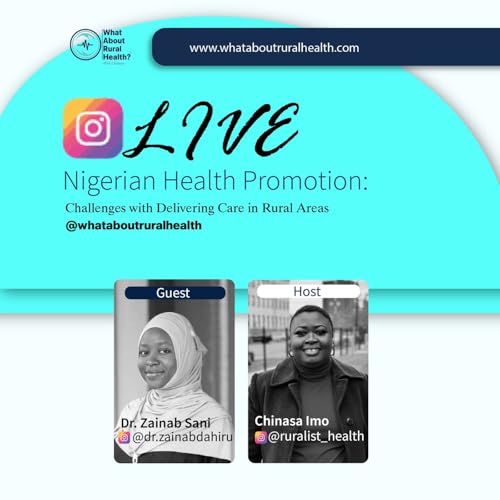
  • Nigerian Rural Health Promotion: Challenges with delivering care in rural areas with Dr. Zainab Dahiru
    Nov 25 2025

    Nigerian Health Promotion: Challenges of Delivering Care in Rural Areas — A Conversation with Dr. Zainab Dahiru

    In this episode of What About Rural Health?, host Chinasa Imo speaks with Dr Zainab Dahiru, a dedicated primary healthcare doctor whose experience serving in Saye Village offers a rare and honest look into the realities of rural healthcare in Nigeria.


    Dr. Zainab shares the inspiration behind her work and opens up about the barriers that make health promotion and care delivery incredibly difficult in remote communities — from understaffed facilities to transportation challenges and resource limitations.


    She highlights the most common diseases affecting rural populations, and how stigma, deeply rooted cultural beliefs, and widespread misinformation often stand in the way of timely care. Through her stories, we see how cultural context shapes health behaviours — and why community trust is just as important as medical treatment.


    This episode sheds light on what it truly takes to serve rural communities: compassion, cultural sensitivity, and an unwavering commitment to improving health outcomes where it matters most.


    Tune in for a powerful, eye-opening conversation about the heart of rural healthcare in Nigeria.

    Want to be a guest on What About Rural Health?™? Send Chinasa Imo a message on PodMatch, here: https://podmatch.com/hostdetailpreview/1762029634065133df1c28412

    Show More Show Less
    1 hr and 12 mins
  • Frontlines & Frameworks: Rural Health Through the Eyes of a First Responder with Peterson Wachira Hsc
    Nov 8 2025

    In this episode, we sit with Peterson Wachira, a seasoned Clinical Officer, Infectious Disease Expert, and National Chairperson of the Kenya Union of Clinical Officers (KUCO) — and a recipient of the Head of State Commendation Award.

    Wachira offers an unfiltered look into Kenya’s health system — breaking it down from Level 1 community centers to Level 6 national hospitals, while highlighting how primary healthcare truly begins at the grassroots.

    He discusses:

    • The crucial distinction between medical officers and clinical officers
    • The 360° approach to bettering healthcare for both workers and patients
    • How systemic failures during Ebola and COVID-19 exposed gaps in preparedness
    • Why pandemic readiness must be proactive, not reactive
    • The shortage of clinical officers and the impact on rural healthcare delivery
    • How community health promoters are empowering citizens to demand stronger health policies during elections

    Want to be a guest on What About Rural Health?™? Send Chinasa Imo a message on PodMatch, here: https://www.podmatch.com/hostdetailpreview/1762029634065133df1c28412

    Listen to this powerful conversation on the realities, lessons, and hope within Kenya’s healthcare system.

    Show More Show Less
    52 mins
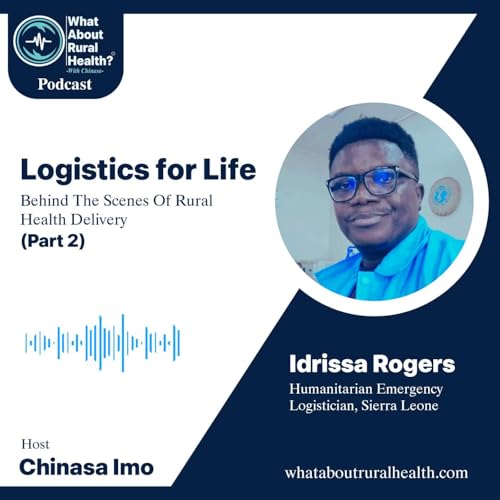
  • Logistics for Life (Part 2): Behind The Scenes Of Rural Health Delivery with Idrissa Rogers
    Oct 22 2025

    In this second part of our conversation with Idrissa Rogers, a seasoned logistics and supply chain professional with over a decade of experience in humanitarian and development work, we dive deeper into the real challenges and hard truths shaping rural healthcare delivery.

    Idrissa sheds light on:
    The unpredictability of transport systems and why every logistics plan needs a backup plan.
    The cracks within rural healthcare supply chains — from systemic corruption to apathy toward innovation.
    The rise of innovative tools like iPads and digital systems transforming field logistics.
    And most importantly, the selfless mindset required to truly thrive in health logistics.

    This episode is a must-listen for anyone passionate about health systems, logistics, innovation, and impact work in underserved communities.

    Subscribe to stay updated on new episodes of What About Rural Health?™ — where we share real stories, real challenges, and real change from the field.

    #RuralHealth #Logistics #HealthcareInnovation #WARHPodcast #WhatAboutRuralHealth #PublicHealth #HumanitarianWork

    Show More Show Less
    40 mins
  • Logistics for Life (Part 1): Behind The Scenes Of Rural Health Delivery with Idrissa Rogers
    Oct 15 2025

    In this episode, we go behind the scenes of rural health delivery with Idrissa Rogers, a seasoned logistics and supply chain professional with over a decade of experience in humanitarian and development work.

    From poor infrastructure and river-dependent communities to corruption and internal bottlenecks, Idrissa paints a raw and honest picture of what it really takes to deliver essential health supplies to remote areas of Sierra Leone.

    He shares how logistics isn’t just about transport — it’s about access, trust, and life itself. Idrissa discusses the importance of local partnerships, the role of transparency in ensuring successful delivery, and introduces the RED ROSE system — a digital tool used by UNICEF to onboard beneficiaries and ensure accountability in distributing malaria relief materials.


    This conversation opens our eyes to the unsung heroes of rural health — the logisticians, field coordinators, and partners who make access possible, one shipment at a time.

    Show More Show Less
    30 mins