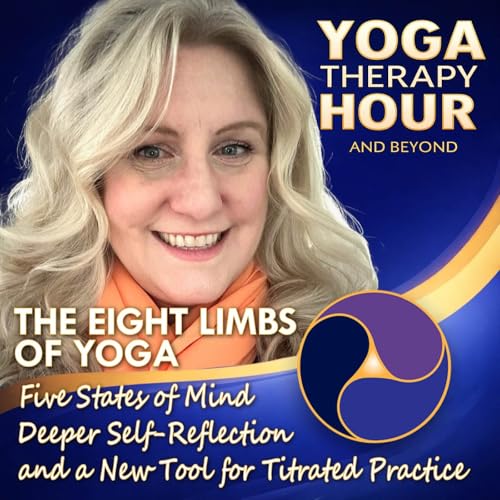
Yoga Therapy Hour with Amy Wheeler cover art

Yoga Therapy Hour with Amy Wheeler

Yoga Therapy Hour with Amy Wheeler

Written by: Amy Wheeler
Listen for free

Welcome to "The Yoga Therapy Hour Podcast," a harmonious blend of ancient wisdom and modern science, brought to life by Amy's expertise in psychology and public health. With over 100,000 downloads, this podcast delves deep into the principles of yoga therapy, offering expert interviews, practical solutions, and profound insights into real-life challenges.

From its inception, the first four seasons have been instrumental in elevating the domain of yoga therapy, emphasizing the pivotal role of lifestyle medicine in addressing both our mental and physical well-being. As we transition into Season 5, 6 & 7, Amy broadens the horizon, reaching out to the masses. Here, listeners will unravel how yoga therapy, when intertwined with lifestyle engineering, can serve as a powerful tool for holistic healing, touching the realms of the mind, body, and spirit.

Subscribe now and be part of a transformative journey that bridges the essence of embodied mental health with the spirit's depth. Join Amy in redefining mental and physical wellness. Also, leave us a review if you are enjoying the podcast and consider supporting us at the Optimal State & Yoga Therapy Hour Patreon page -https://www.patreon.com/yogatherapyhour


Go to www.TheOptimalState.com for more details on how to improve your mental and emotional health!

All rights reserved.
Alternative & Complementary Medicine Biological Sciences Economics Education Exercise & Fitness Fitness, Diet & Nutrition Hygiene & Healthy Living Management Management & Leadership Physical Illness & Disease Psychology Psychology & Mental Health Science Self-Help Social Sciences Spirituality Success
Episodes
  • Five States of Mind, Deeper Self-Reflection, and a New Tool for Titrated Practice
    May 15 2026

    In this solo episode, Amy returns to one of the heart-teachings of Patañjali’s Yoga Sūtra: learning to observe the fluctuations of mind and how they shape behavior, communication, and the way we show up in relationship and daily life. Rather than analyzing or diagnosing, she frames this as svādhyāya—steady self-reflection rooted in classical yoga philosophy.

    Amy walks listeners through Vyāsa’s five states of mind (citta-bhūmi)—from restlessness and dullness to one-pointed focus and absorption—and then explores how a meditation practice naturally moves beyond surface thoughts into the deeper layers of experience: vijñānamaya kośa (discernment, beliefs, identity patterns) and ānandamaya kośa (inner coherence, ease, meaning, and trust).

    She also introduces contemplative inquiry through vāsanā (habitual tendencies), saṃskāra (deep patterning), and the kleśas (root causes of suffering)—not as labels, but as invitations to notice what is repeating and to support wise change over time.

    In the final section, Amy shares an emerging project: a Yoga Philosophy Self-Reflection Coach—a custom AI-based chat tool designed to support brief, titrated self-inquiry and help people choose a targeted meditation practice in small daily doses. She addresses common concerns about mixing yoga and technology, emphasizes that human connection still matters, and offers thoughtful privacy guidance.

    In This Episode, You’ll Hear

    • Why yoga emphasizes observation over self-judgment
    • How the mind’s fluctuations drive behavior, communication, and relational patterns
    • The five states of mind (citta-bhūmi) through Vyāsa’s lens
    • How meditation moves from surface-level “daily tasks” into deeper inquiry
    • Vijñānamaya kośa reflections: beliefs, identity, reactivity vs. response, recurring patterns
    • Ānandamaya kośa reflections: meaning, manageability, coherence, ease, trust
    • Using the kleśas as a compassionate framework for seeing the roots of suffering
    • Why people often stop meditating—and how “small, titrated bits” can help
    • A preview of the Yoga Philosophy Self-Reflection Coach and how it’s designed to work
    • Practical privacy boundaries when using AI for personal reflection
    • Why Amy believes there is room for both technology and human teachers/therapists

    A Few Reflective Questions to Take into Practice

    • What is the current quality of my mind and heart?
    • What pattern keeps repeating beneath the surface?
    • Is there an identity I’m protecting that creates friction or suffering?
    • What am I grasping for—or avoiding—that might be shaping my choices?
    • Where might more space create more coherence?

    Mentioned Resource

    Amy shares that listeners who want to beta test the Yoga Philosophy Self-Reflection Coach can contact her through her website: www.theoptimalstate.com.

    Gentle Reminder

    This episode offers philosophical self-inquiry grounded in yoga tradition. It is not presented as diagnosis or mental health treatment. If you need more support, consider working with a qualified yoga therapist and/or licensed mental health professional.

    Show More Show Less
    36 mins
  • Post-Traumatic Growth and Neuroplasticity: Healing in Present Time with Colleen Millen
    May 8 2026
    What happens when we stop treating suffering as a fixed identity and start relating to it as a changeable state?In this conversation, Amy Wheeler is joined by Colleen Millen, a licensed marriage and family therapist and yoga therapist who works at the intersection of somatic psychotherapy, nervous system regulation, and post-traumatic growth. Colleen shares how “healing happens in present time,” why choice and consent are foundational to real change, and how small, repeatable practices can reshape patterns that once felt permanent.Together, they explore neuroplasticity in everyday language (“neurons that fire together wire together”), how somatic tracking restores access to the prefrontal cortex when stress responses take over, and why therapy and yoga therapy can be most effective when they are collaborative—rooted in agency, curiosity, and what is life-affirming for the individual. In This Episode, You’ll HearWhy post-traumatic growth can be a more empowering framework than only focusing on post-traumatic stressHow agency and consent orient the healing process (“Do you even want to rewire this?”)A practical, listener-friendly explanation of Dan Siegel’s “hand model of the brain” and what it means to “keep the lid on”How somatic approaches support regulation when words aren’t accessibleWhy short-term coping practices can lead to long-term changeWhat it looks like to track psychobiological shifts in real time and “stay with” the moment of the changeA grounded reframe: depression or anxiety can feel like a trait—until, over time, it becomes “a jacket that doesn’t fit anymore”How yoga philosophy (including kriyā yoga and bhāvanā/intentionality) can support behavior change without forcing a one-size-fits-all approachThe role of telehealth in expanding access—especially for postpartum clients and busy householders Key Moments (listener roadmap)Colleen’s path: journalist → yoga teacher (since 1999) → LMFT journey (began 2009; licensed 2018)Why “post-traumatic growth” matters: hope, agency, and the possibility of a new relationship to sufferingSomatic psychotherapy basics: how stress shows up through the body (breath, belly, skin, heart rate)Window of tolerance + polyvagal orientation: getting a “map” for the nervous systemDan Siegel’s hand model: a clear explanation for both audio and YouTube listenersNeuroplasticity in daily life: how intention + repetition + small practices reshape what’s possiblePresent-time stabilization: why you don’t always need to “go into the past” to healRepetition and practice: why the micro-moments matter—and how real change accrues over time Practical Takeaways (gentle, doable)Name the moment: “Something just happened.”Anchor in the body: feel your feet, notice your breath, sense support from the chair.Choose one tiny action you can repeat (a short walk, a grounding pause, a few breaths, a hand on the heart).Track the shift: What changes in your breath, pace, sensation, or clarity when you slow down?Repeat: consistency is what makes the new pathway more available under stress. About Colleen Millen (LMFT-CA)Colleen Millen is a somatic psychotherapist and yoga therapist who supports clients navigating anxiety, depression, and the desire for post-traumatic growth. Her work emphasizes nervous system education, present-time stabilization, and collaborative inquiry that honors choice, pace, and lived experience. She currently offers telehealth and hybrid services in California. Resources MentionedNARM (NeuroAffective Relational Model) — inquiry, agency, and what you want for yourselfPolyvagal Theory — understanding states and regulationWindow of Tolerance — a framework for tracking arousal and capacityDan Siegel’s Hand Model of the Brain — “flipping the lid,” cortex/offline vs. online regulation supportInterpersonal Neurobiology / Mindsight (Dan Siegel) Connect with Colleen (California)Positive Counseling & Psychology: PositiveCounselingPsychology.comRula: Rula.com
    Show More Show Less
    51 mins
  • Cleaning the Lens: How Daily Practice Rewrites Belief, Body, and Behavior
    May 1 2026

    In this solo reflection, Amy explores why daily practice matters beyond flexibility, strength, or stress relief. Using a simple morning ritual—cleaning her glasses—she offers a clear metaphor for what practice does: it helps us notice what has accumulated in the mind-body system and gives us a way to “wipe the lens” so we can see, sense, and choose more clearly.

    This episode weaves yogic psychology, behavior change, and neuroscience into one steady message: our beliefs don’t just shape our thoughts—they shape our bodies, our felt sense, and our default responses. The work of change is possible, but it asks for time, repetition, and a compassionate willingness to witness what’s already wired.

    In this episode, Amy explores

    • Why daily practice functions like “cleaning the lens” of perception
    • How repetitive beliefs shape behavior, communication, and lived experience
    • The neuroscience of habit loops: “neurons that fire together wire together”
    • Why beliefs become embodied—and how sensations can become predictable over time
    • How yoga therapy supports change from both directions: top-down and bottom-up
    • The importance of cultivating the observer before trying to rewire patterns
    • How mantra, mudrā, saṅkalpa, and visualization can interrupt old loops and build new ones
    • Why meaningful rewiring often takes years, not weeks
    • How the ego can resist change when long-held patterns feel “cement-like”
    • Why dramatic life changes don’t always create transformation if beliefs remain unchanged
    • How yoga therapy stays self-empowered while still benefiting from skilled guidance
    • A woven framework: Rāja Yoga (mind), Haṭha Yoga (body), and a mature, non-bypassing view of Vedānta
    • A thoughtful comparison between Vedānta and The Matrix as a metaphor for misperception and awakening

    Key takeaways

    • Change begins with awareness: noticing the loop without immediately obeying it.
    • The body and mind are trained together; sustainable change includes both sensation and belief.
    • Practice is not about perfection—it’s about repetition with clarity.
    • External reinvention can create space, but real change comes from rewiring the underlying beliefs.
    • A mature spiritual framework supports healing without bypassing what is real and human.

    Reflection question for listeners

    What is one familiar “loop” you notice in your mind-body system—and what might it feel like to pause, witness it, and choose a new response today?

    Mentioned in this episode

    • Daily practice as a method of “cleaning the lens”
    • Behavior change and learning theory
    • Rāja Yoga and the Yoga Sūtra as a practical path for health, healing, and liberation
    • Haṭha Yoga as a pathway back into sensation and embodiment
    • Advaita Vedānta and the movement from perceived separateness toward wholeness
    • The role of a yoga therapist or guide in supporting insight without bypassing


    Show More Show Less
    39 mins
adbl_web_anon_alc_button_suppression_c
No reviews yet