Episodes

  • What retail buyers want from beauty brands | Billie Faricy-Hyett | THG | Ex. NET-A-PORTER, Harrods
    Nov 23 2026

    Getting your product into a big beauty retailer is one challenge. Making the launch work once you're listed is another.

    Billie Faricy-Hyett, Chief Buying Officer at THG, decides which brands go into LookFantastic, Cult Beauty and Dermstore, and she joins Adam Wright in this episode to share what beauty buyers look for.

    Her team are sent hundreds of new brands a week. A brand that can't explain itself quickly can get missed, even with a great product. So what gets a brand through, and what keeps it there once it's launched?

    UK beauty is the most price-driven market in Europe, and TikTok Shop is now where many people make their first beauty purchase.

    Billie shares the 3 hurdles every brand has to clear, from the first email to the product itself, and what makes her team get behind a brand after launch. She also tells the story of a brand with a single product that broke all the rules.

    In this episode

    - From the shop floor at Monsoon and Accessorize to buying at Harrods

    - Joining Net-a-Porter when luxury online was still unproven

    - Why your peers can be your best mentors

    - What beauty buyers look for in a new brand

    - The 3 hurdles every brand has to clear to get stocked

    - The single-product brand that broke the rules

    - What makes a retailer get behind a brand after launch

    - Sampling at LookFantastic and Cult Beauty, from in-store sampling bars to advent calendars

    - Competing in Europe's most price-driven beauty market

    - TikTok Shop and the first beauty purchase


    Key takeaways

    - A buyer first asks whether the customer needs your product and whether there's a gap for it

    - Your first email to pitch buyers has to look good and tell your story clearly

    - Know why the world needs your product before you pitch it

    - Show the buyer where your brand goes next

    - A launch needs a joint plan for the months after it, not just launch day

    - Getting product into customers' hands brings them back to buy

    - Give customers a reason to choose you beyond price


    Follow Beyond the Brand for conversations with marketing leaders from household names and challenger brands, hosted by Adam Wright, CMO at Sampl.


    Resources and links

    Billie Faricy-Hyett on LinkedIn

    THG Beauty website

    THG on LinkedIn

    Adam Wright on LinkedIn

    Read Adam's takeaways from this episode on Substack


    This episode was produced by Sampl, the digital sampling platform that gets product samples to the right consumers and tracks what happens next. Visit www.sampltech.com for more information and to book a demo.

    Show More Show Less
    47 mins
  • How to sell a product that takes 12 weeks to work | Carol McEvoy | Symprove
    Nov 4 2026

    Most subscription brands try to win a customer over in 30 days, but Symprove ask their customers to commit for 3 months.

    Carol McEvoy, Head of PR, Social and Advocacy at the UK gut health brand, joins Adam Wright to explain how they earn that commitment.

    Carol calls Symprove "a considered product", in a category where a new supplement brand can appear almost overnight. So what keeps a customer with a product long enough to judge it? The answer applies to any product that takes time to show what it does, from skincare to pet food.

    Carol explains why she'd happily rename her job head of advocacy, and why Symprove turn down creators who haven't used the product. She also talks about what a sample is for when the benefit takes weeks. Then there's the time they sent Lisa Snowdon to a village called Shitterton.


    In this episode

    - Moving from Penguin and HarperCollins to employee number 8 at Symprove

    - Putting the finished product through clinical studies

    - Customer care that's never on the clock

    - Running PR, social and advocacy as one team

    - Sending Lisa Snowdon to Shitterton, and why repetition matters as much as big ideas

    - Working only with creators and experts who use the product

    - Standing out in a noisy supplement category

    - Asking customers to commit for 12 weeks

    - What a sample can do when the benefit takes weeks

    - Plans for the US


    Key takeaways

    - Build trust before you ask for a long commitment

    - Make the first step smaller than the full commitment

    - Let the people who already trust you do the recommending

    - Work only with creators who already use your product

    - Use samples to remove the taste and format barrier

    - Repeating a true message keeps reaching new people


    🎙️ Who is telling your customers your product is worth sticking with?


    Follow Beyond the Brand for conversations with marketing leaders from household names and challenger brands, hosted by Adam Wright, CMO at Sampl.


    Resources and links

    Carol McEvoy on LinkedIn

    Symprove websiteSymprove on LinkedInAdam Wright on LinkedInBEYOND THE BRAND is produced by Sampl, the digital sampling platform that gets product samples to the right consumers and tracks what happens next.

    Show More Show Less
    33 mins
  • Julia Kessler (Fiid) on the impact of GLP-1, managing a rebrand, and moving from founder to hired CEO
    Oct 9 2026

    This episode of Beyond the Brand looks at three big questions food and drink brands are facing right now. What do weight loss drugs mean for what people eat? How do you change a brand people already love without losing them? And what happens when you run a brand you didn’t build?

    A lot of the industry sees GLP-1 as a threat. Fewer snacks, smaller baskets, less booze. But for some brands, the shift could work in their favour, as long as they handle it carefully.

    To talk it through, Adam is joined by Julia Kessler, CEO of Fiid, a B Corp plant-based food brand from Dublin making high protein, high fibre meals that are ready in 90 seconds. Julia spent 12 years in tech supply chain at BlackBerry and QuickBooks, then co-founded spicy soft drink brand Nix and Kix, which sold around 30 million units and was stocked in Waitrose, Tesco, Sainsbury’s and Morrisons.

    In this honest, practical conversation, Julia explains why she sees GLP-1 as good news, how she rebranded Fiid within six months without losing loyal shoppers, and why time spent in supermarket aisles still shapes the decisions she makes.

    In This Episode

    • Why GLP-1 is driven by consumers, not regulation, and why that means it will stick
    • How one person on the drug can change what a whole household eats
    • Why Fiid chose not to put “GLP-1 friendly” on pack
    • Dropping “vegan” from the pack and leading with protein, fibre and veg instead
    • Changing packs and recipes at the same time, and why she kept the name
    • How promos, sampling and in-store displays protected shoppers at launch, and how rate of sale doubled
    • Going from founder to hired CEO, and making decisions with less emotional attachment
    • Watching shoppers in the aisle, and why “pink is a flavour”

    Key Takeaways

    🔹 GLP-1 is a change led by consumers, so it’s here to stay🔹 You can design for a trend without putting it on the label🔹 Shoppers shop with their eyes first, so every pack needs to stand out on shelf🔹 A relaunch needs trial behind it, not just a new pack🔹 For a new or different product, getting it into people’s hands is the biggest driver🔹 Only launch NPD if it can do as well as your best seller

    Resources & Links

    Find Fiid in store or online https://www.eatfiid.com/Connect with Julia on LinkedIn https://www.linkedin.com/in/innovationflow/
    Follow Beyond the Brand for future episodes

    💬 Is GLP-1 changing how your brand thinks about product, pack or positioning?
    Share your thoughts in the comments.

    📲 Don’t forget to follow the podcast and leave a review. It really helps these conversations reach more people.

    Show More Show Less
    46 mins
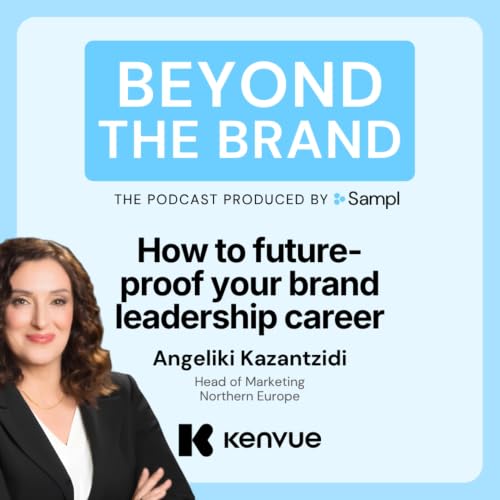
  • How to future-proof your brand leadership career | Angeliki Kazantzidi | Kenvue
    Sep 8 2026

    Twenty years into a marketing career built across six countries and 40-plus brands, staying relevant has meant reinventing more than once, not settling into one version of the job.

    In this episode, Angeliki Kazantzidi, Head of Marketing Northern Europe at Kenvue, joins Adam to talk through what that reinvention has looked like, from a chemistry degree and an SAP consulting job to leading some of the biggest names in skincare and self-care.

    Guest bio

    Angeliki Kazantzidi is Head of Marketing Northern Europe at Kenvue, leading 6 countries and more than 40 brands including Neutrogena, Aveeno, Listerine and Calpol. Her career spans over 20 years across consumer health, FMCG, and B2B, with roles in Greece, Switzerland, Spain, and now the UK.

    Show More Show Less
    31 mins
  • The product proof your competitors can't copy | Sarah Booth | Ancient + Brave
    Jul 27 2026

    Any competitor can cite the same ingredient study you cite.

    Looking credible has gotten cheap, and the science page, the citations, and the claims that used to set a brand apart are now within reach of anyone with a product and a browser.

    What's left is the evidence you own about your own finished product, and that's what Sarah Booth has built Ancient + Brave around.

    Sarah is Chief Brand and Creative Officer at Ancient + Brave, the wellness brand that grew more than 1,400% in 2 years and holds the highest B Corp score of any UK supplement company.

    Before this, she led brand strategy at ASOS and ran brand and marketing at Ovo Energy. She started in zoology, which turns out to matter for how she runs a wellness brand.

    Sarah and Adam get into the difference between evidence about an ingredient, which everyone in your category can point to, and evidence about your product, which only you hold.

    In the episode:

    → Why nobody outside your business will ever fund a study on your actual product
    → The Nike test for whether the evidence you're citing is really yours
    → How Ancient + Brave's clinical trial surfaced a benefit they weren't looking for
    → What open customer feedback tells you that lab testing can't
    → Why owned evidence gets more valuable as your category fills with new entrants

    If you've watched a newer brand launch with claims that sound just like yours, this one's about what you can build that they can't lift.

    Beyond the Brand is brought to you by Sampl—smarter product trials, measurable from request to review to sale.

    Show More Show Less
    43 mins
  • Why the most overlooked customer is the biggest opportunity | Peony Li | Jude
    Jun 30 2026

    Peony Li built Jude by serving the customer that almost everyone else in women's health overlooks: older women.

    She and Adam talk through how she built around them, from imagery that shows older women with dignity to a 30,000-strong community that now shapes the brand and gave Jude its first-ever employee.

    The conversation covers growing a brand when ad platforms restrict the words you need to reach people, and why genuine care for a customer is the one thing a competitor cannot copy.

    Peony is the founder and CEO of Jude, the women's health brand now stocked in around 2,000 UK stores. Before launching it, she spent 3 years investing at Founders Factory.

    Show More Show Less
    43 mins
  • How to make sceptics your growth engine | Max Henderson | Co-founder & CEO | Hotpod Yoga
    Jun 8 2026

    Max Henderson started Hotpod Yoga in 2013 with his childhood friend Nick, despite neither of them being yoga people at the time. Today, Hotpod Yoga is Europe's largest yoga business in 3 countries with over 500,000 customers.

    Most of those customers arrived sceptical about yoga, or were put off by it altogether. So Hotpod stopped leading with yoga and started selling the experience around it: the pod, the heat, the scent, the music, a space that shuts the outside world out.

    The yoga happens once you're already in the room.

    In this episode, Max and Adam get into how he built a brand that looks nothing like its category, why looking radically different did the heavy lifting on changing perception, how referrals turn sceptical first-timers into regulars, and what he learned from a 4-year rebrand and 18 months of barely trading through COVID.

    There's also a sharp section on using partnerships to stay culturally relevant.

    If you're trying to win customers who've already decided your category isn't for them, this one's worth your time.

    Show More Show Less
    42 mins
  • From social to shelf without a pitch | Hannah Samano | Founder and CEO | Unfabled
    May 27 2026

    From social to shelf without a pitch

    Hannah Samano left Unilever at the height of the direct-to-consumer boom to build something from nothing. She's now founder and CEO of Unfabled, a women's health and supplements brand that has gone from a pure D2C launch to 730+ Boots stores, Holland & Barrett online and 61 Sainsbury's stores, without ever pitching for that first retail deal.

    In this episode Hannah tells Adam how Boots messaged them a month after their first supplement line went live, why she's grown revenue 10x in two years with six full-time people, and how a D2C-native brand ends up with an advantage on a supermarket shelf that bigger players don't have.

    It's a practical conversation for anyone in FMCG weighing up the crossover between digital and retail. What actually transfers, what doesn't, and why Hannah reckons retail "feels less rickety" than D2C.

    In this episode

    • Why she walked away from Unilever's D2C push, and what from that playbook still earns its keep
    • Taking a six-person team to 10x revenue, and the communication maths behind staying lean
    • What Unfabled keeps in-house (growth, IP, product development) versus what it briefs out
    • "Retail chose us": the Boots Ignite story and the jump from 50 to 737 stores
    • Using community data to win on shelf, and bringing personalisation to the shelf edge
    • Repositioning creatine for women, away from the gym-bro association it has carried for decades
    • Selling everyday health next to the bread and milk, and building trust in two seconds
    • What has shifted in women's health, and the $1 trillion number that changed the funding conversation

    Chapters01:36 . Hannah's path: Unilever, Nairobi and a focus on female health03:31 . Leaving Unilever at the peak of the D2C bubble06:37 . What transfers from a corporate playbook to a startup12:17 . The case for a deliberately lean team15:41 . Building the systems that let a small team move fast16:39 . What stays in-house and what gets briefed out18:54 . "Retail chose us": the Boots Ignite story23:17 . Unfabled Labs, community data and the shelf-edge advantage26:14 . Repositioning creatine for women29:17 . Winning trust in two seconds on a Sainsbury's shelf32:38 . D2C versus retail, and why retail feels less rickety35:29 . South by Southwest, and momentum as a startup's currency37:14 . What's changed in women's health, and the $1 trillion shift39:13 . Where to find Hannah and Unfabled

    About Hannah and UnfabledHannah Samano is the founder and CEO of Unfabled, a women's health and supplements brand she started in 2021 after struggling to find products that worked for her own hormonal health. Before that she spent several years at Unilever, including a spell at Unilever Ventures and on the team that built its first in-house D2C personal care brand.

    Unfabled: unfabled.co, and on Instagram and TikTokHannah: Hannah Samano on LinkedIn

    Listen and subscribeBeyond The Brand is a bi-weekly podcast and newsletter for marketers learning from the people shaping the future of brands. New episodes on Spotify, Apple Music, Amazon Music, Substack and LinkedIn.

    Show More Show Less
    41 mins