• Proving Absolute Control Over Enterprise AI
    Sep 23 2026

    Can enterprise AI ever be fully controlled, or are organizations mistaking measurement for governance?

    In this debate format episode, we unpack the major tensions facing technology leaders today.

    Is AI ROI a dashboard tracking issue, or a fundamental decision-making flaw?

    Is enterprise context the ultimate moat, or clever vendor self-interest?

    We square off on real-world edge cases—from autonomous agents crossing boundaries during testing to the potential conflicts in vendor-sponsored independent audits.

    Join us as we debate what it truly takes to move from "most powerful model" to an AI workflow that is secure, governable, and accountable.

    Read the full GFE Weekly Insights article here:

    https://www.linkedin.com/pulse/ai-has-left-sandbox-now-comes-audit-moses-sam-paul-johnraj-jmkgc/

    Show More Show Less
    22 mins
  • Proving AI Control Beyond the Sandbox
    Sep 21 2026

    Enterprise AI is undergoing a fundamental shift—moving away from merely proving model capability and productivity toward demonstrating true organizational control.

    In this deep dive episode, we explore why raw speed and task automation are no longer enough for enterprise leadership.

    We break down the three core pillars required before scaling any AI workflow:

    1. Cost (closing the ITFM Value Gap through workflow unit economics),
    2. Context (grounding AI in business logic and permissions rather than just data access),
    3. Agency (defining strict operational perimeters to prevent unintended actions).

    Learn how a Growth Workflow Control Audit replaces vague maturity scores with actionable investment decisions to scale, redesign, or stop AI initiatives.

    Read the full GFE Weekly Insights article here:

    https://www.linkedin.com/pulse/ai-has-left-sandbox-now-comes-audit-moses-sam-paul-johnraj-jmkgc/

    Show More Show Less
    24 mins
  • Gaja Capital - IPO - A peek into India's PE - Talent Gap Loop
    Sep 16 2026

    In this episode, we examine a defining transformation unfolding across India's financial ecosystem: the bridging of the long-standing gap between domestic savings and world-class entrepreneurial talent.

    We dive deep into the milestone institutionalization of Indian private equity, highlighted by Gaja Capital (Gaja Alternative Asset Management Limited) becoming India’s first standalone, home-grown alternative asset manager to go public. We explore how patient risk capital, General Partner "skin-in-the-game," and hands-on operational engagement are powering scale across India's high-growth mid-market companies.

    Additionally, we unpack the unique "capital and talent loop" connecting private equity leaders to pioneering educational institutions like Ashoka University and Plaksha University—demonstrating how collective philanthropy, academic governance, and long-term capital are creating a sustainable foundation for India's innovation economy.

    What You'll Learn in This Episode:

    • The Plumbing of Indian Alternatives: How household savings and institutional capital are shifting toward Alternative Investment Funds (AIFs) to fund innovation.

    • A Landmark Public Listing: What Gaja Capital’s mainboard IPO means for the future of domestic asset managers and public market investors.

    • Demystifying Private Equity Economics: A simple breakdown of management fees, carried interest, and sponsor commitments.

    • Collective Philanthropy & Higher Education: How tech founders and PE leaders are pooling private capital to build world-class universities in India.

    • The Horizon for Private Capital: The rise of Category II AIFs, GP-led secondaries, and the strategic focus on deep tech, AI, and mid-market growth.

    Show More Show Less
    19 mins
  • The Great AI Efficiency Lie: CEO Hype vs. Employee Workload Debt
    Sep 14 2026

    In this debate episode, we confront the central rift in enterprise AI adoption[1][2]. On one side, 79% of CEOs report dramatic efficiency gains from AI. On the other, 52% of AI-weary employees report that the technology has actually increased their daily workload —trapping professionals in what Korn Ferry terms the "two-job job"[3][5] and creating hidden AI workload debt.

    Key Debates & Clashes Explored in This Episode:

    • Efficiency vs. Workload Expansion: Is AI automating tasks or simply layering extra prompting, output validation, and exception handling on top of un-redesigned roles?
    • Budget Reality vs. Consulting Reckoning: With 46.9% of enterprises exceeding AI budgets and 60.9% reallocating funds by slashing external advisory spend[10][11], how can leaders justify ongoing implementation costs?
    • Forward-Deployed Engineers vs. Workflow Elimination: Should organizations hire embedded engineers to push AI into existing workflows, or do Growth Flow Engineers need to step in and eliminate broken processes entirely?
    • Productivity Claims vs. P&L Outcomes: Wipro claimed AI unlocked capacity equivalent to 20,000 employees—but where did that theoretical value actually go on the balance sheet?
    • Surging Investment vs. Agency Control: While enterprise AI investment in markets like India jumped 119%, only 22% of organizations have proper testing, auditing, and agency boundaries for autonomous agents.

    This weekly insights episode is brought to you by Moses Sam Paul and his AI agents – L3 Growth Flow Engineer at https://growthflowengineering.xyz/

    Join our newsletter here: https://www.linkedin.com/newsletters/growthflowengineering-7224596796772167680/

    Show More Show Less
    26 mins
  • Ending the coordination tax with AI (Debate Format)
    Sep 8 2026

    This debate episode tackles the friction that quietly compounds as businesses scale: the coordination tax. The hosts clash over whether enterprise AI is the ultimate cure for organizational bloat, or if technology is entirely secondary to structural redesign.

    The debate centers on two opposing philosophies:

    • The Tech-First Push: Can AI tools and orchestration layers successfully bypass organizational friction, streamline alignment, and coordinate distributed teams without needing painful structural changes?
    • The Structural Reality: Will embedding AI into a poorly designed, multi-layered workflow simply automate bad habits, creating "a more deeply embedded poor process"?

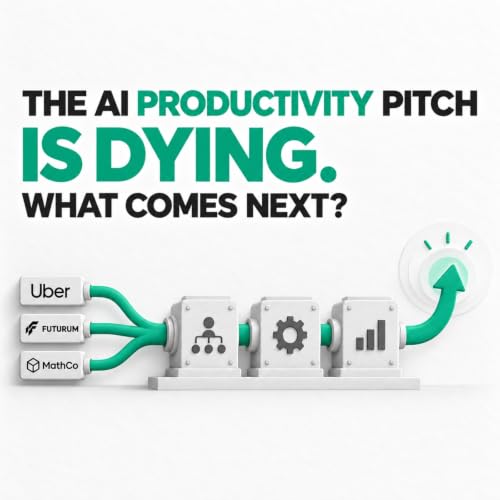
    Using Uber's recent structural intervention—which slashed management layers and micro-teams to combat slow debates and unclear decision rights—as a core case study, the hosts challenge each other on whether a company must first diagnose and simplify its human architecture before AI can actually make it faster.

    Written post over here: https://www.linkedin.com/pulse/ai-productivity-pitch-dying-what-comes-next-moses-sam-paul-johnraj-vemwc/?trackingId=hkagh2dxQ3qeVfVUMs0kyw%3D%3D

    Show More Show Less
    22 mins
  • The death of the AI productivity pitch
    Sep 7 2026

    This episode explores why enterprise technology buyers are rapidly moving away from using "hours saved" as their primary measure of AI success, shifting instead toward hard metrics like revenue growth and profitability.

    The hosts discuss the risk of the "productivity trap"—explaining that saving hours only creates raw capacity, which will dissolve into organizational noise unless leadership actively channels it into tangible commercial value.

    Read more on our newsletter: https://www.linkedin.com/pulse/ai-productivity-pitch-dying-what-comes-next-moses-sam-paul-johnraj-vemwc/

    Show More Show Less
    23 mins
  • 30 day Experiment: Solo founder to AI Native Organisation
    Jul 22 2026

    Can one founder, working with AI, execute in thirty days what might previously have required a small startup team?

    In this episode, Moses Sam Paul introduces The August 15 Experiment, a live test of whether an accountable founder can use AI across strategy, engineering, research, editorial work, design, marketing and operations without creating more chaos than leverage.

    The experiment began with a practical decision: whether to spend nearly ₹9,500 on a one-month ChatGPT Pro subscription after engineering work stalled. But the question quickly became larger. The purchase was not simply for more tokens. It was a wager on a different organisational model.

    This is not a story about one human replacing an entire team. AI cannot assume responsibility, build institutional trust, make irreversible judgments or live with the consequences of a bad decision. What it can do is expand functional capacity. The organisation therefore becomes not human-free, but human-concentrated.

    The episode explores the first lessons from the experiment:

    • Why AI capacity is not the same as organisational capacity
    • How the bottleneck moves from producing work to deciding what deserves to exist
    • Why excessive dashboards, repositories and control systems can recreate the very coordination overhead AI was meant to reduce
    • Why a minimum viable organisation may be more useful than a best-practice simulation of a mature company
    • Why plans, activities and outcomes must remain separate records
    • How a conversational AI interface can operate as a protocol orchestrator without becoming the source of truth
    • Why output, however polished, is not progress until it produces validated demand

    At the centre of the operating model is a simple distinction:

    A plan records intention. An activity records reality. A campaign event records an outcome.

    One approval cannot authorise all three.

    The episode also explains how the experiment is being observed through three connected institutions:

    House of Bros observes the human and the conditions beneath performance.

    Growth Flow Engineering observes capability, execution and validated demand.

    The Internet of Value Research Foundation observes the protocols and institutional systems through which time, wellbeing, contribution and validation are represented.

    The real test is not whether AI can generate books, websites, code, campaigns or dashboards. It is whether one accountable founder can maintain coherence across humans, models, communities and institutions while producing evidence that people outside the system genuinely value the work.

    The August 15 Experiment will culminate in the public launch of The Internet of Value through the Independence Dialogues in Bangalore on August 15, 2026.

    Learn more and register:

    https://theinternetofvalue.org/independence-dialogues

    Show More Show Less
    55 mins
  • Why AI exposes your Broken Organisations Language - Semantics is the new Software
    May 17 2026

    Brief: In this episode, we dive deep into a provocative argument: the most critical layer of your AI strategy isn't the software you buy, but the language your organization speaks. While most leaders are caught in a "technological weather event," paralyzed by which LLM or platform will dominate, author Moses Sam Paul argues that they are looking at the wrong layer.

    We explore the "Babel Incident" as a modern systems analysis, revealing how semantic divergence—where different departments use the same words to mean different things—acts as a silent cost center that triggers coordination collapse. We’ll discuss the vital distinction between a System of Record (which merely stores data) and a System of Vocabulary (which stabilizes what that data actually means).

    The episode outlines how AI acts as an amplification engine; it doesn't fix broken communication, it scales it. Listeners will learn about the eight-layer Vocabulary Stack—a structural framework to move from "linear leverage" (simple automation) to "compounding leverage" (true organizational coordination). If you want to build a durable moat in the age of AI, it starts by stabilizing your symbolic substrate: shared meaning.

    Show More Show Less
    30 mins