Episodes

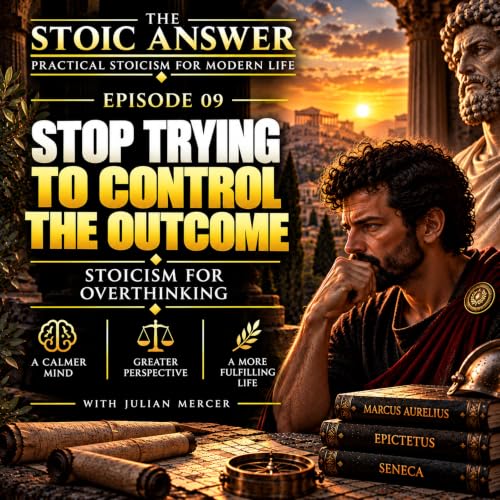
  • Stop Trying to Control the Outcome | Stoicism for Overthinking (Ep. 09)
    Oct 8 2026

    What if the reason you can't stop overthinking is that you're trying to control something that was never yours to control?

    You can prepare carefully, make the right decisions, work hard—and still not get the outcome you wanted.

    That's one of life's most difficult truths.

    And it's exactly where Stoic philosophy can help.

    In this episode of THE STOIC ANSWER, we explore how to stop obsessing over outcomes, release the need for certainty, and focus your energy on what you can actually control.

    Drawing on the practical wisdom of Epictetus and ancient Stoic philosophy, we examine the difference between taking responsibility for your actions and demanding guarantees from life.

    IN THIS EPISODE:

    • Why uncertainty makes us overthink
    • The difference between what you control and what you can only influence
    • How to prepare without becoming attached to the result
    • Why trying to guarantee success can undermine your peace of mind
    • How to handle disappointment without losing your direction
    • How to practice Stoicism in everyday decisions

    THE CENTRAL LESSON:

    Your responsibility is to act with wisdom, discipline and integrity.

    The outcome is not always yours to decide.

    You don't have to stop caring about your goals.

    You have to stop making your peace of mind depend entirely on whether you achieve them.

    REFLECTION QUESTION:

    What outcome are you trying too hard to control right now?

    THE STOIC ANSWER
    Practical Stoicism for Modern Life

    Written by Julian Mercer.

    Explore THE STOIC ANSWER books on overthinking, difficult people, regret and the principles of Stoicism:

    https://link.amazon/B0ebz04FK

    Follow THE STOIC ANSWER on Spotify for more practical Stoic philosophy, self-discipline and ancient wisdom for modern life.

    Show More Show Less
    8 mins
  • When Thinking Becomes the Problem | A Stoic Guide to Overthinking
    Oct 3 2026

    When does thinking stop helping—and start becoming the problem?


    You begin with a real question, decision, conversation, or worry. Thinking seems useful at first. But then the same possibilities begin repeating. You search for certainty, reconsider what you already considered, and mentally rehearse outcomes that haven't happened.


    Eventually, you're no longer solving the problem.


    You're circling it.


    In Episode 8 of **THE STOIC ANSWER**, Julian Mercer explores a practical Stoic approach to overthinking—and how to recognize when reflection has stopped producing clarity.


    Drawing on the principles of **Marcus Aurelius, Epictetus, and Seneca**, this episode explores how to separate what is within your control from what isn't, distinguish facts from the stories your mind creates, and know when you've thought about something enough.


    You'll discover:


    • Why useful thinking should eventually lead toward judgment or action

    • How the desire for certainty can keep overthinking alive

    • The Stoic distinction between what is and isn't within your control

    • How to separate facts from assumptions and imagined outcomes

    • Why stopping repetitive thought can itself be an act of discipline

    • A simple Stoic rhythm: **Think. Judge. Act. Wait.**

    • How to recognize when it's time to stop analyzing and return to life


    The goal isn't to stop thinking.


    It's to make thinking useful again.


    **Not every thought deserves another thought.

    Not every possibility needs to be investigated.

    Not every unanswered question can be answered tonight.**


    Sometimes the wisest response is simply:


    **“I've thought about this enough for now.”**


    THE STOIC ANSWER brings ancient Stoic philosophy into modern problems—overthinking, uncertainty, difficult people, regret, discipline, emotional control, and the search for a calmer mind.


    📚 Explore THE STOIC ANSWER books by Julian Mercer:

    https://link.amazon/B0ebz04FK

    Show More Show Less
    9 mins
  • Stop Caring What Everyone Thinks | Stoicism for Social Overthinking
    Sep 25 2026

    How much of your mental energy is spent wondering what other people think of you?

    Did you say the wrong thing? Did they approve? Did you look foolish? Should you explain yourself? Did that criticism mean something — or are you imagining a judgment that was never actually made?

    In Episode 7 of THE STOIC ANSWER, Julian Mercer explores a distinctly modern form of overthinking through the lens of Stoic philosophy: the attempt to manage other people's opinions.

    The Stoic approach is not to ignore everyone or become indifferent to useful criticism. It is to understand the boundary between what deserves your attention and what was never yours to control.

    In this episode, we explore:

    • Why the mind invents judgments that were never expressed
    • How approval-seeking turns other people's opinions into a source of anxiety
    • The difference between useful criticism and imagined judgment
    • Why reputation can become a psychological trap
    • How to stop performing for an imaginary audience
    • What to do when someone genuinely criticizes you
    • How Stoicism redirects attention from approval toward character
    • A practical method for interrupting social overthinking

    The central question becomes simpler:

    Not: “What do they think of me?”

    But:

    “Did I act well?”

    Listen when criticism contains truth. Correct yourself when correction is necessary. Repair what you damage.

    Then release what belongs to another person's mind.

    Other minds are not your work. Your conduct is.

    THE STOIC ANSWER brings classical Stoic principles into modern problems involving overthinking, difficult people, regret, uncertainty, relationships, self-discipline, and everyday decisions.

    Written by Julian Mercer.

    📚 Explore THE STOIC ANSWER books:
    https://link.amazon/B05WvVqop

    Show More Show Less
    9 mins
  • How to Deal With Uncertainty — A Stoic Answer to Overthinking
    Sep 22 2026

    How do you live well when you don't know what happens next?

    Uncertainty can keep the mind trapped in a cycle of checking, predicting, rehearsing, and overthinking. We tell ourselves that one more thought, one more check, or one more possible scenario might finally make us feel secure.

    But certainty often isn't available.

    In this episode of THE STOIC ANSWER, we explore a Stoic approach to uncertainty, fear of the future, and the need to know what happens next.

    Drawing on the practical philosophy associated with Epictetus, Marcus Aurelius, and Seneca, we examine a crucial distinction: what belongs to you — and what does not.

    Your preparation is yours.
    Your effort is yours.
    Your judgment is yours.
    Your response is yours.

    The final outcome may not be.

    You'll explore why constant checking can reinforce uncertainty, how preparation differs from mental rehearsal, and how to recognize when there is genuinely nothing more to solve right now.

    A simple question becomes central:

    Is there useful information available now that I haven't examined?

    Is there a useful action available now that I haven't taken?

    If the answer to both is no, more thinking may not create more control.

    Sometimes the task is simply to tolerate the unanswered question.

    “I do not know yet — and I can continue anyway.”

    Prepare for reality.

    Don't pre-live every possibility.

    Leave the unfinished future unfinished.

    THE STOIC ANSWER brings ancient Stoic philosophy to modern problems including overthinking, regret, difficult people, uncertainty, self-control, and resilience.

    📚 Explore THE STOIC ANSWER books by Julian Mercer:
    https://link.amazon/B05WvVqop

    Show More Show Less
    10 mins
  • How to Make Decisions Without Second-Guessing Yourself | A Stoic Guide
    Sep 19 2026

    How do you make a decision when you cannot know for certain whether it is the right one?

    You consider the options. You weigh the risks. You finally choose.

    Then the second-guessing begins.

    What if I made the wrong decision?
    What if the other option was better?
    What if I overlooked something?

    In Episode 5 of THE STOIC ANSWER, Julian Mercer explores a practical Stoic approach to difficult decisions, uncertainty, and the exhausting habit of repeatedly reopening choices you've already made.

    In this episode, you'll learn how to:

    • Separate facts from assumptions
    • Distinguish careful preparation from endless prediction
    • Identify what is actually within your control
    • Stop treating uncertainty as evidence that you chose badly
    • Compare real options instead of idealizing the path you didn't take
    • Recognize when new information genuinely justifies reconsideration
    • Make a reasonable choice without demanding certainty about the future

    The Stoic Decision Filter:

    Facts → Assumptions → Control → Values → Available Information → Choose

    Stoicism does not promise that every decision will produce the outcome you hoped for.

    It offers something more realistic: a way to think carefully, choose responsibly, and then move forward without demanding knowledge of a future you cannot control.

    A reasonable decision does not require certainty.

    Think carefully. Choose responsibly. Then move.

    THE STOIC ANSWER — Practical Stoicism for Modern Life

    📖 THE STOIC ANSWER by Julian Mercer
    https://amzn.to/4gIYqjH

    Show More Show Less
    10 mins
  • Stop Replaying Conversations in Your Head | A Stoic Solution
    Sep 14 2026

    Do you replay conversations long after they end?

    You think about what you should have said, what the other person meant, whether you sounded wrong, or how you could have handled the moment differently.

    This episode of THE STOIC ANSWER looks at the Stoic way to separate useful reflection from repetitive mental replay.

    You’ll learn how to:

    • separate facts from interpretation
    • stop trying to control what other people think
    • deal with the “perfect response” you thought of too late
    • repair genuine mistakes without endless self-punishment
    • stop imaginary arguments in your head
    • use a simple Stoic method: Facts → Lesson → Repair → Release → Return to the Present

    The past can teach you. It cannot be edited.

    THE STOIC ANSWER is practical Stoicism for modern life, inspired by the ideas of Marcus Aurelius, Epictetus, Seneca, and the broader Stoic tradition.

    📖 THE STOIC ANSWER by Julian Mercer
    https://amzn.to/4gIYqjH

    Show More Show Less
    10 mins
  • Your Thoughts Are Not Facts | A Stoic Guide to Overthinking
    Sep 8 2026

    A thought appears: They are angry with me. I'm going to fail. Something is wrong. I made the wrong decision.

    Within seconds, the mind can stop treating that thought as a possibility and start treating it as reality.

    In Episode 3 of THE STOIC ANSWER, we explore one of the most useful Stoic ideas for overthinking: an impression is not the same thing as a fact.

    Drawing on Epictetus and the Stoic concepts of impression and assent, this episode examines how the mind fills uncertainty with stories—and how we can create space between what appears in our mind and what we choose to believe.

    In this episode:
    • How a fact becomes a story
    • Why uncertainty invites interpretation
    • Epictetus on impressions and assent
    • Why repeated thoughts begin to feel true
    • How familiarity can be mistaken for evidence
    • The three-step Stoic pause
    • Why you don't need to fight every unwanted thought
    • How to separate useful reflection from overthinking
    • Turning thought into practical action

    You cannot control every thought that enters your mind.

    But you can become more disciplined about what happens next.

    A thought is not a verdict.

    THE STOIC ANSWER brings practical Stoicism to modern life.

    Based on THE STOIC ANSWER book series by Julian Mercer.

    Think more clearly. Respond better. Focus on what you can control.

    Show More Show Less
    11 mins
  • Stop Suffering in Advance | Stoicism for Fear and Overthinking
    Sep 8 2026

    How much suffering comes from what has actually happened—and how much comes from what you fear might happen?

    The meeting is tomorrow. The result comes Friday. Someone hasn't replied. A difficult decision is approaching. Nothing has happened yet, but your mind is already living through the worst possible outcome.

    In Episode 2 of THE STOIC ANSWER, we explore Seneca's insight that we often suffer more in imagination than in reality—and how Stoicism can help us prepare for uncertainty without repeatedly rehearsing pain.

    In this episode:
    • Why fear is not evidence
    • How one future event can steal several days of the present
    • The difference between preparation and prediction
    • Why worry often disguises itself as responsibility
    • The “midnight courtroom” of overthinking
    • What to do when your fear is genuinely reasonable
    • How to keep difficult situations in proportion
    • Why Stoic confidence doesn't require believing everything will be fine
    • Three questions to ask when anticipatory fear takes over

    Stoicism doesn't promise that nothing difficult will happen.

    It offers a different challenge:

    Prepare where preparation is useful. Respond when reality arrives. Let the future arrive once.

    THE STOIC ANSWER brings practical Stoicism to modern life.

    Based on THE STOIC ANSWER book series by Julian Mercer.

    Think more clearly. Respond better. Focus on what you can control.

    Show More Show Less
    12 mins