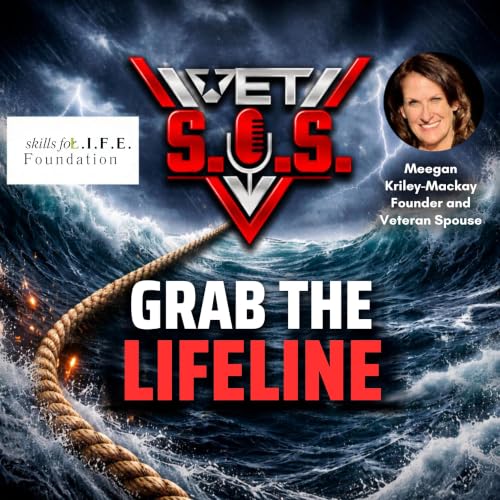
VET S.O.S. Podcast cover art

VET S.O.S. Podcast

VET S.O.S. Podcast

Written by: Shawn Welsh Keith Cassant Eric Brew Mark Elder; Hira Paulin; Kingsley Scott
Listen for free

VET S.O.S. is a military transition focused organization dedicated to helping service members, veterans, and military families navigate transition and thrive in civilian life. Through four targeted shows, we deliver resources, insights, and inspiration: Military Transition Resources Show shares tools and programs for a smoother transition; Veteran Entrepreneurial Spotlight features veteran business journeys; Veteran Educational Resources Spotlight highlights learning opportunities; and The Scoop offers engaging discussions and fresh perspectives.Shawn Welsh, Keith Cassant, Eric Brew, Mark Elder; Hira Paulin; Kingsley Scott Self-Help Success
Episodes
  • Why Veterans Need Human Intelligence in the Age of AI - Skills for L.I.F.E. Foundation
    Oct 7 2026

    Your military skills may qualify you for the job. Your people skills may determine whether you actually get it.

    Meegan Kriley-Mackay knows that distinction firsthand. After watching her former spouse—a highly experienced Air Force C-17 pilot—struggle in civilian job interviews, she realized technical expertise wasn't the problem. He had the skills to do the job but needed the people skills to get the job.

    That experience helped launch the Skills for Life Foundation and a methodology designed to strengthen the human intelligence veterans, military spouses, and families need to communicate, adapt, and lead beyond the uniform.

    In this episode, you'll discover:

    • Translate your military expertise into human connection by understanding why technical qualifications alone may not carry you through a civilian interview.

    • Apply the LIFE methodology—Look and Listen, Imagine, Focus, Empower—to recognize old patterns, assess what's happening now, and deliberately move toward a new goal.

    • Strengthen your human intelligence by developing EQ, SQ, AQ, situational awareness, nonverbal communication, and other people skills that Meegan says can be learned and improved.

    • Understand why AI makes human intelligence even more important, and why Meegan believes developing HI alongside AI will be critical for the future of leadership and work.

    About Meegan Kriley-Mackay

    Meegan Kriley-Mackay is a military spouse, former U.S. Department of Defense Human Intelligence Specialist, certified interrogator, author, leadership strategist, and founder of the Skills for Life Foundation. Her transition work grew from helping her former spouse, an Air Force C-17 pilot, develop the people skills he needed to successfully move into commercial aviation.

    Her work now combines human intelligence, neuroscience, communication, and leadership to help transitioning service members, veterans, military spouses, and families prepare for life beyond the uniform.

    If this episode helped you, please follow the show and leave a 5-star review on Apple Podcasts — open the app, search VET S.O.S., scroll down, and tap "Write a Review." It takes 30 seconds and puts this show in front of a veteran who needs it right now.

    Explore the Full VET S.O.S. Network

    ▶ VET S.O.S. — Flagship Show
    ▶ VET S.O.S. Presents: Operation Startup
    ▶ VET S.O.S. Presents: Learning Lifeline
    ▶ VET S.O.S. Presents: The Scoop
    ▶ VET S.O.S. Presents: Testimony Strong

    Connect with VET S.O.S.

    Website: vetsospodcast.com
    Twitter: @vetsospodcast
    LinkedIn: linkedin.com/company/vetsospodcast
    YouTube: youtube.com/@vetsospodcast
    Facebook: facebook.com/vetsospodcast
    Instagram: instagram.com/vetsospodcast
    TikTok: tiktok.com/@vetsospodcast

    #VETSOS #VeteranPodcast #GrabTheLifeline #HeroesMediaGRP #MilitaryTransition #HumanIntelligence #VeteranCareers #LeadershipDevelopment #ArtificialIntelligence #MilitarySpouse #Podcast #Veterans #MilitaryLife


    Show More Show Less
    25 mins
  • AI Is Changing Veteran Jobs: How to Stay Mission Ready
    Sep 30 2026

    EPISODE PREMISE

    AI is changing the workforce. Veterans can fear the change—or learn how to put it to work.

    AI doesn't have to replace your experience—it can extend what you already know.

    Ted Adair and Kris Saling break down how AI Mission Ready helps veterans, military spouses, and caregivers move beyond AI hype and build practical tools for real problems. The bigger conversation goes deeper than technology: identity after service, rebuilding structure, finding purpose, and preparing yourself for a workforce changing faster than traditional transition programs can keep up.

    In this episode, you'll discover:

    • Learn why Kris says AI takes over tasks—not jobs—and why your experience and domain knowledge still matter when evaluating what AI produces.

    • See how an 82nd Airborne veteran built an AI agent to triage community emails, prioritize issues, and turn hours of administrative work into roughly 15 minutes a day.

    • Recognize why trying to copy and paste the entire military ecosystem into your first civilian job can leave you struggling with identity, structure, community, and purpose.

    • Understand the AI Mission Ready model: practical training, live coaching, small "fire teams," and a requirement to finish with a functional asset—not just another certificate.

    About Ted Adair & Kris Saling

    Ted Adair is a fourth-generation Army combat veteran and former field artillery officer who completed two deployments, including a 14-month combat tour in Iraq. After two decades in federal consulting and growth strategy, he founded Oath & Oak to help veterans, military spouses, and caregivers build economic agency in an AI-enabled world.

    Kris Saling is a people analytics and talent management expert, Director of Workforce Transformation at IBR, author of Data-Driven Talent Management, and founder of the Navigator Foundation. Her experience at the intersection of workforce transformation, data, technology, and people brings an important perspective to understanding what AI can—and cannot—do.

    🎙️ If this episode helped you, please follow the show and leave a 5-star review on Apple Podcasts — open the app, search VET S.O.S., scroll down, and tap "Write a Review." It takes 30 seconds and puts this show in front of a veteran who needs it right now.

    🎧 Explore the Full VET S.O.S. Network

    ▶ VET S.O.S. — Flagship Show
    ▶ VET S.O.S. Presents: Operation Startup
    ▶ VET S.O.S. Presents: Learning Lifeline
    ▶ VET S.O.S. Presents: The Scoop
    ▶ VET S.O.S. Presents: Testimony Strong

    🔗 Connect with VET S.O.S.

    Website: vetsospodcast.com
    Twitter: @vetsospodcast
    LinkedIn: linkedin.com/company/vetsospodcast
    YouTube: youtube.com/@vetsospodcast
    Facebook: facebook.com/vetsospodcast
    Instagram: instagram.com/vetsospodcast
    TikTok: tiktok.com/@vetsospodcast

    #VETSOS #VeteranPodcast #GrabTheLifeline #HeroesMediaGRP #ArtificialIntelligence #AIWorkforce #MilitaryTransition #VeteranEmployment #VeteranTransition #Veterans #MilitaryLife #Podcast #MilitaryCommunity #FutureOfWork


    Show More Show Less
    25 mins
  • The Missing Link in Veteran TBI? Your Neck May Hold the Answer
    Sep 23 2026

    VET S.O.S. — Veteran Transition, Resources & Brain Health

    What if your lingering concussion symptoms aren't coming only from your brain—but from an injury everyone missed?

    A veteran can have clear scans and still battle headaches, brain fog, dizziness, sleep problems, and hypervigilance years after a mild traumatic brain injury. Army veteran Dr. Chris Slininger believes part of the problem may be that we're examining the brain while overlooking what happened to the neck during the same blast, impact, or concussion.

    In this episode, Dr. Slininger breaks down his research into the craniocervical junction and explains why asking "What did the kinetic force do?" may be more useful than simply asking where someone was hit.

    In this episode, you'll discover:

    • Recognize common long-term MTBI symptoms—including headaches, migraines, dizziness, brain fog, cognitive decline, sleep disruption, and persistent fight-or-flight responses.

    • Understand why Dr. Slininger believes the upper cervical spine deserves greater attention after blast exposure, concussions, airborne injuries, vehicle accidents, and other high-force events common in military service.

    • Learn how neurological communication, blood flow, and cerebrospinal fluid flow factor into his theory about the relationship between the upper neck and brain function.

    • Explore the veteran MTBI research he's building—from an initial 10-person pilot to a planned 400-person randomized controlled trial comparing brain-focused and craniocervical interventions, including former NFL players as a comparison group.

    About Dr. Chris Slininger

    Dr. Chris Slininger is a U.S. Army Reserve veteran who deployed to Kuwait in 2004–2005 and served in both the Engineer Corps and Medical Corps. His exposure to service members dealing with blast-related injuries helped drive his focus toward brain health and the invisible wounds associated with MTBI.

    Today, his clinical work focuses on complex neurological conditions and the craniocervical junction. He is leading research examining whether upper cervical correction can affect persistent symptoms associated with mild traumatic brain injury in veterans.

    Learn more:
    cerebralchiropractic.com
    mtbiresearch.com

    Support VET S.O.S.

    If this episode helped you, please follow the show and leave a 5-star review on Apple Podcasts — open the app, search VET S.O.S., scroll down, and tap "Write a Review." It takes 30 seconds and puts this show in front of a veteran who needs it right now.

    Episode Chapters

    00:00 — Introduction: Back Pain, Brain Health & the Invisible Wound
    03:36 — Dr. Slininger's Army Service and Transition
    08:33 — Fighting Red Tape to Continue the Mission
    09:31 — How Does the Spine Affect the Brain?
    15:07 — What a Concussion Can Do to the Neck
    19:38 — Building a Veteran MTBI Research Study
    21:36 — Battlefield vs. Playing Field: Veterans and NFL Players
    24:28 — Precision Upper Cervical Correction Explained
    28:17 — Headaches, Brain Fog, Dizziness & Hypervigilance
    31:12 — Dr. Slininger's Own History of Multiple MTBIs
    33:18 — Research, Resources & How to Get Involved
    35:06 — Closing & Resources

    Explore the Full VET S.O.S. Network

    ▶ VET S.O.S. — Flagship Show
    ▶ VET S.O.S. Presents: Operation Startup
    ▶ VET S.O.S. Presents: Learning Lifeline
    ▶ VET S.O.S. Presents: The Scoop
    ▶ VET S.O.S. Presents: Testimony Strong

    Connect with VET S.O.S.

    Website: vetsospodcast.com
    Twitter: @vetsospodcast
    LinkedIn: linkedin.com/company/vetsospodcast
    YouTube: youtube.com/@vetsospodcast
    Facebook: facebook.com/vetsospodcast
    Instagram: instagram.com/vetsospodcast
    TikTok: tiktok.com/@vetsospodcast

    #VETSOS #VeteranPodcast #GrabTheLifeline #HeroesMediaGRP #VeteranBrainHealth #TBI #MTBI #TraumaticBrainInjury #ConcussionRecovery #InvisibleWounds #VeteranHealth #MilitaryHealth #MilitaryTransition #Veterans #MilitaryLife #Podcast


    Show More Show Less
    36 mins
adbl_web_anon_alc_button_suppression_t1
No reviews yet