• Episode 49: American College of Lifestyle Medicine Dr Meagan Grega - How Does Lifestyle Influence Health?
    Nov 18 2026

    Dr. Meagan Grega is the Co-Founder and Chief Medical Officer of Kellyn Foundation, and President-Elect for the American College of Lifestyle Medicine.

    Dr. Meagan Grega is the Co-Founder and Chief Medical Officer of Kellyn Foundation, a 501(c)3 non-profit dedicated to making the Healthy Choice the Easy Choice. Kellyn provides school-based healthy lifestyle education and "Garden as a Classroom" programs; supports access to nutrient-dense produce via the Eat Real Food Mobile Market; engages participants in hands-on, plant-based cooking classes in community settings and offers intensive therapeutic lifestyle change interventions for individuals and families. Dr. Grega earned her MD degree from the University of Pennsylvania Medical School and spent several years as a medical officer in the United States Navy. She is honored to serve as faculty for the St. Luke's University Health Network Anderson Campus Family Medicine and Internal Medicine Residency programs, and Clinical Assistant Professor for the Lewis Katz School of Medicine at Temple University. She serves on the Board of Directors of the American College of Lifestyle Medicine, the American Board of Lifestyle Medicine, and the American College of Lifestyle Medicine, and is board certified in both Family Medicine and Lifestyle Medicine.

    TOPICS EXPLORED

    0:00 – 0:21 – Introduction

    0:21 – 2:03 – Dr. Meagan Grega's bio

    2:03 – 4:22 – What is the American College of Lifestyle Medicine and what type of work does it do?

    4:22 – 7:22 – How would you define lifestyle medicine?

    7:22 – 9:10 – How did you become interested in the connection between lifestyle and health?

    9:10 – 14:28 – People may hear the term "Food is Medicine." How would you define that phrase, and why is it important?

    14:28 – 17:40 – What type of training do most medical students receive regarding lifestyle, and how do you think medical education could be improved?

    17:40 – 20:17 – What are some of the main barriers for most people to have a healthy lifestyle, and how do you think these challenges can be overcome?

    20:17 – 23:31 – How do you like to work with patients to help them achieve better health outcomes?

    23:31 – 28:24 – In addition to being a doctor, you are also the co-founder of Kellyn Foundation. Could you tell me about Kellyn Foundation and the work that it does?

    28:24 – 30:50 – How can people work together to create healthier communities?

    30:50 – 33:43 – How can it become easier for people to make choices that are better for their health?

    33:43 – 36:47 – Are there examples of how to make healthy food choices easier, and how do you think they can be replicated?

    36:47 – 39:27 – What are the most important advances in lifestyle medicine?

    39:27 – 42:47 – What do you see as the future of sustainable food and health?

    42:47 – 43:34 – Things to share and wrap up

    AMERICAN COLLEGE OF LIFESTYLE MEDICINE

    https://lifestylemedicine.org/

    KELLYN FOUNDATION

    https://www.kellyn.org/

    FOOD FOR YOU AND THE PLANET PODCAST INFORMATION

    Apple Podcasts: https://podcasts.apple.com/us/podcast/food-for-you-and-the-planet/id1739416396

    Spotify: https://open.spotify.com/show/7pkAIuXxl9dzD48b7qMOL1

    RSS: https://feeds.libsyn.com/506343/rss

    Podcast Instagram: @foodforyouandtheplanet

    TAGS

    Food

    Environment

    Health

    Podcast

    Sustainability

    Lifestyle Medicine

    American College of Lifestyle Medicine

    Kellyn Foundation

    Food Is Medicine

    Show More Show Less
    44 mins
  • Episode 48: Farm Sanctuary Gene Baur - How Does Farm Sanctuary Advocate For Animals?
    Oct 7 2026

    Gene Baur is the Co-Founder and President of Farm Sanctuary.

    Gene Baur has been hailed as "the conscience of the food movement" by Time magazine. Since the mid-1980s, he has traveled extensively, campaigning to raise awareness about the abuses of industrialized factory farming and our system of cheap food production. A pioneer in the field of undercover investigations and farm animal rescue, Gene has visited hundreds of farms, stockyards, and slaughterhouses, documenting the deplorable conditions. His pictures and videos exposing factory farming cruelties have aired nationally and internationally, educating millions about the plight of modern farm animals, and his rescue work inspired an international farm sanctuary movement.

    TOPICS EXPLORED

    0:00 – 0:22 – Introduction

    0:22 – 1:24 – Gene Baur's bio

    1:24 – 3:06 – What is Farm Sanctuary and what type of work does it do?

    3:06 – 5:38 – How did you become interested in food and farming?

    5:38 – 8:07 – Could you tell me about your path which led you to create Farm Sanctuary?

    8:07 – 10:54 – How has the concentration of corporate power in our food system changed the way food is produced and consumed?

    10:54 – 14:30 – What are some facts about industrial agriculture and its impact on animals that people should know?

    14:30 – 19:09 – What are ag gag laws, and how do they shape the information people receive about our food system?

    19:09 – 21:55 – I understand you are a vegan. If an animal were to be slaughtered for food, are there methods during the process of it being raised, and the slaughter process itself that you think are more humane?

    21:55 – 24:15 – You participated in a famous debate surrounding the motion, "Don't eat anything with a face," which has been watched by hundreds of thousands of people. Could you tell me a little bit about that experience and some of your key points?

    24:15 – 27:22 – You did an IronMan when you were 50 years old on an entirely vegan diet. What was that experience like, and what are your thoughts on more athletes choosing plant-based diets including the athletic benefits?

    27:22 – 31:03 – What do you think are the most effective ways to create change in the world?

    31:03 – 34:29 – Farm Sanctuary is celebrating its 40th anniversary this year. What are some of the most important moments in the organization so far?

    34:29 – 37:16 – What do you see as the future of sustainable food and farming?

    37:16 – 38:31 – Things to share and wrap up

    FARM SANCTUARY

    Farm Sanctuary: https://www.farmsanctuary.org/

    RESOURCES

    Farm Sanctuary The Story of A Movement: https://bookshop.org/p/books/farm-sanctuary-the-story-of-a-movement-gene-baur/5ed305c72af50cf6

    FOOD FOR YOU AND THE PLANET PODCAST INFORMATION

    Apple Podcasts: https://podcasts.apple.com/us/podcast/food-for-you-and-the-planet/id1739416396

    Spotify: https://open.spotify.com/show/7pkAIuXxl9dzD48b7qMOL1

    RSS: https://feeds.libsyn.com/506343/rss

    Podcast Instagram: @foodforyouandtheplanet

    TAGS

    Food

    Environment

    Health

    Podcast

    Sustainability

    Agriculture

    Farming

    Farm Sanctuary

    Show More Show Less
    39 mins
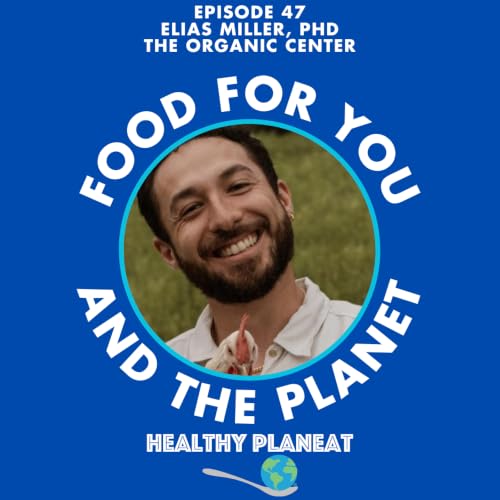
  • Episode 47: The Organic Center Elias Miller PhD - What Is The Organic Center?
    Sep 9 2026

    Elias Miller, PhD is the Manager of Science Programs at The Organic Center.

    Elias Miller, PhD leads initiatives designed to advance scientific understanding and support the adoption of sustainable agricultural practices. Formally trained in ecology, animal behavior, and discipline-based education research, he brings an interdisciplinary lens to his work at the intersection of science, education, and food systems.

    TOPICS EXPLORED

    0:00 – 0:22 – Introduction

    0:22 – 0:59 – Elias Miller, PhD's bio

    0:59 – 2:00 – What is The Organic Center and what type of work does it do?

    2:00 – 3:21 – How did you become interested in organic agriculture?

    3:21 – 4:29 – Why is it important for farmers to farm organically, and for people to shop for organic food?

    4:29 – 5:37 – What type of research do you do at The Organic Center?

    5:37 – 7:34 – What are some of the most important findings of your research at The Organic Center?

    7:34 – 8:58 – How does The Organic Center work to share its research findings with farmers, the general public, and policymakers?

    8:58 – 10:22 – What types of policies do you think could help increase organic food production and consumption?

    10:22 – 11:51 – Can you tell me about The Organic Center's fellowships and internships programs?

    11:51 – 13:59 – How does regenerative agriculture fit into the organic movement?

    13:59 – 15:17 – What do you see as the future of organic food?

    15:17 – 16:27 – Things to share and wrap up

    THE ORGANIC CENTER:

    The Organic Center: https://organic-center.org/

    RESOURCES

    The Organic Center Research: https://organic-center.org/research

    The Organic Center Resource Library: https://organic-center.org/resource-library

    The Organic Center Recipes: https://organic-center.org/organic-recipes

    FOOD FOR YOU AND THE PLANET PODCAST INFORMATION

    Apple Podcasts: https://podcasts.apple.com/us/podcast/food-for-you-and-the-planet/id1739416396

    Spotify: https://open.spotify.com/show/7pkAIuXxl9dzD48b7qMOL1

    RSS: https://feeds.libsyn.com/506343/rss

    Podcast Instagram: @foodforyouandtheplanet

    TAGS

    Food

    Environment

    Health

    Podcast

    Sustainability

    Agriculture

    Farming

    Organic

    The Organic Center

    Show More Show Less
    16 mins
  • Episode 46: Purdue University Professor Emeritus Don Huber - What Are The Impacts Of GMOs And Pesticides?
    Aug 5 2026

    Dr. Don Huber is Professor Emeritus of Plant Pathology at Purdue University.

    Dr. Don Huber received B.S. and M.S. degrees from the University of Idaho, a PhD from Michigan State University, and is a graduate of the US Army Command and General Staff College and Industrial College of the Armed Forces. His agricultural research the past 50 years has focused on the epidemiology and control of soilborne plant pathogens with emphasis on microbial ecology, cultural and biological controls, and physiology of host-parasite relationships. He is author or co-author of more than 300 journal articles and three books.

    TOPICS EXPLORED

    0:00 – 0:24 – Introduction

    0:24 – 1:25 – Dr. Don Huber's bio

    1:25 – 1:46 – How did you become interested in food and agriculture?

    1:46 – 3:00 – What are some key facts people should know about soil health and its importance to our food system?

    3:00 – 6:00 – What are genetically modified organisms and how are they used in our food system?

    6:00 – 10:07 – What is glyphosate, the active ingredient in weed killers such as Roundup, and how is it used?

    10:07 – 13:02 – How has the use of glyphosate impacted soil health and human health?

    13:02 – 16:51 – What are ways people can minimize their exposure to glyphosate, and other synthetic chemicals used in our food system?

    16:51 – 20:52 – Is there any way for people to remove glyphosate from their system?

    20:52 – 27:39 – You served as an Agricultural Program Specialist for the US Department of Agriculture National Plant Disease Recovery System. What type of work did you do in that role, and why is it important for there to be understanding about the causes of plant disease and ways to recover from it?

    27:39 – 29:54 – What are some of your favorite highlights of your career so far?

    29:54 – 33:23 – How can society shift from the use of synthetic chemicals in our food system to one that is more environmentally sustainable?

    33:23 – 34:54 – What do you see as the future of healthy and environmentally sustainable food?

    34:54 – 38:07 – Things to share and wrap up

    DR. DON HUBER:

    Purdue University: https://ag.purdue.edu/department/btny/directory-btny.html

    RESOURCES

    Research Publications: https://www.researchgate.net/profile/Dm-Huber

    Rodale Institute Organic Stewardship Award Winners: https://rodaleinstitute.org/organic-stewardship-award-winners/

    FOOD FOR YOU AND THE PLANET PODCAST INFORMATION

    Apple Podcasts: https://podcasts.apple.com/us/podcast/food-for-you-and-the-planet/id1739416396

    Spotify: https://open.spotify.com/show/7pkAIuXxl9dzD48b7qMOL1

    RSS: https://feeds.libsyn.com/506343/rss

    Podcast Instagram: @foodforyouandtheplanet

    TAGS

    Food

    Environment

    Health

    Podcast

    Sustainability

    Agriculture

    Farming

    Diet

    Nutrition

    Organic

    Pesticides

    Glyphosate

    Roundup

    Show More Show Less
    38 mins
  • Episode 45: Bionutrient Food Association Dan Kittredge - How Can We Grow Nutrient-Dense Food?
    Jul 8 2026

    Dan Kittredge is the Founder and Executive Director of the Bionutrient Food Association.

    Dan Kittredge is a lifelong farmer, educator, and passionate advocate for growing nutrient-dense food. With decades of experience in regenerative agriculture and a deep understanding of soil science, Dan has made it his mission to empower farmers, gardeners, and consumers to unlock the full potential of their crops and landscapes. Growing up on an organic farm, Dan witnessed firsthand the challenges and opportunities of cultivating healthy, sustainable food systems. Over the years, he developed a keen interest in the intersection of soil health, plant vitality, and human well-being. This journey led him to found the Bionutrient Food Association, a nonprofit organization dedicated to promoting food quality as the central tenet of health and sustainability.

    TOPICS EXPLORED

    0:00 – 0:22 – Introduction

    0:22 – 1:27 – Dan Kittredge's bio

    1:27 – 4:05 – What is The Bionutrient Food Association and what type of work does it do?

    4:05 – 7:28 – How did you become interested in food and agriculture?

    7:28 – 9:33 – What is bionutrient food?

    9:33 – 15:05 – Can you explain the basics of the relationship between soil biology, plant health, and nutrition?

    15:05 – 19:06 – How can farmers implement practical strategies for improving soil structure, fertility, and water retention?

    19:06 – 21:52 – What are some of the tools farmers can use to measure the quality of their soil?

    21:52 – 29:00 – What is some of the cutting-edge research being done on nutrient dense food?

    29:00 – 33:57 – What are some of the impacts of pesticides on human health?

    33:57 – 36:41 – What types of food should consumers look for when they shop so that they can maximize the nutrients they are receiving from their food?

    36:41 – 39:11 – How can society foster a more sustainable and resilient food system that benefits both farmers and consumers?

    39:11 – 42:52 – What do you see as the future of healthy and environmentally sustainable food?

    42:52 – 43:06 – Things to share and wrap up

    THE BIONUTRIENT FOOD ASSOCIATION:

    The Bionutrient Food Association: https://www.bionutrientinstitute.org/

    RESOURCES

    The Bionutrient Institute: https://www.bionutrientinstitute.org/

    Bionutrient Data Explorer: https://app.surveystack.io/static/pages/dataExplorer

    FOOD FOR YOU AND THE PLANET PODCAST INFORMATION

    Apple Podcasts: https://podcasts.apple.com/us/podcast/food-for-you-and-the-planet/id1739416396

    Spotify: https://open.spotify.com/show/7pkAIuXxl9dzD48b7qMOL1

    RSS: https://feeds.libsyn.com/506343/rss

    Podcast Instagram: @foodforyouandtheplanet

    TAGS

    Food

    Environment

    Health

    Podcast

    Sustainability

    Nutrition

    Bionutrient Food Association

    Nutrient Density

    Show More Show Less
    43 mins
  • Episode 44: Minorities In Aquaculture Imani Black - What Is Sustainable Aquaculture?
    Jun 10 2026

    Imani Black is the Founder and CEO of Minorities In Aquaculture.

    Imani Black is an African American oyster farmer who was born and raised on the eastern shore of Maryland. She comes from a long family history of watermen that dates back over 200 years. In 2020, she founded Minorities In Aquaculture, a non-profit that strives to provide support and useful aquaculture education to underrepresented demographics to ensure a better future for aquaculture.

    TOPICS EXPLORED

    0:00 – 0:23 – Introduction

    0:23 – 1:09 – Imani Black's bio

    1:09 – 1:47 – What is aquaculture?

    1:47 – 6:29 – What is Minorities In Aquaculture and what type of work does it do?

    6:29 – 9:35 – Can you tell me a little bit about your family history and how that shaped your interest in aquaculture?

    9:35 – 13:14 – How did you get started in your career in aquaculture?

    13:14 – 16:45 – Why is sustainable aquaculture important?

    16:45 – 18:51 – What are some of the strategies used in sustainable aquaculture?

    18:51 – 22:45 – How can people incorporate more sustainable seafood into their diets?

    22:45 – 24:58 – What do you see as the future of healthy, sustainable, and delicious food?

    24:58 – 26:48 – How can people get involved with Minorities In Aquaculture?

    26:48 – 27:13 – Things to share and wrap up

    MINORITIES IN AQUACULTURE:

    https://www.mianpo.org/

    RESOURCES

    Minorities In Aquaculture Internship Program: https://www.mianpo.org/mia-internships

    Minorities In Aquaculture

    FOOD FOR YOU AND THE PLANET PODCAST INFORMATION

    Apple Podcasts: https://podcasts.apple.com/us/podcast/food-for-you-and-the-planet/id1739416396

    Spotify: https://open.spotify.com/show/7pkAIuXxl9dzD48b7qMOL1

    RSS: https://feeds.libsyn.com/506343/rss

    Podcast Instagram: @foodforyouandtheplanet

    TAGS

    Food

    Environment

    Health

    Podcast

    Sustainability

    Aquaculture

    Sustainable Aquaculture

    Oysters

    Seafood

    Sustainable Seafood

    Minorities In Aquaculture

    Show More Show Less
    27 mins
  • Episode 43: Tendril Kitchen Rishim Sachdeva - How Can We Cook Delicious Food Using Seasonal Vegetables?
    May 20 2026

    Rishim Sachdeva is the Founder and Head Chef of the Michelin recommended restaurant Tendril in London.

    Rishim Sachdeva has held senior positions at some of the best restaurants in London and India. A couple of years ago, as a self-proclaimed 'hardcore carnivore,' he used Veganuary to challenge himself. "Can I create food that satisfies my cravings as a meat-eater whilst giving me satisfaction as a chef?" The answer was yes and he's never looked back. Inspired by his travels around the world, and not pigeon-holed by cuisine type, Rishim has developed his own cooking style that's unique. Tendril Kitchen showcases what's possible in plant-first food. He knows that reducing our meat intake is great for our bodies and for the planet. And with incredible produce available on our doorsteps, he believes that great vegetables deserve to be the hero.

    TOPICS EXPLORED

    0:00 – 0:22 – Introduction

    0:22 – 1:31 – Rishim Sachdeva's bio

    1:31 – 2:13 – Why did you decide to become a chef?

    2:13 – 4:511 – Can you tell me a little bit about your career path?

    4:51 – 6:59 – Could you tell me about Tendril?

    6:59 – 10:10 – What are some of the most important things you've learned at Tendril?

    10:10 – 12:52 – What makes Tendril unique?

    12:52 – 14:01 – Why did you decide to make Tendril a mostly vegan kitchen?

    14:01 – 16:27 – What are things you consider when you create new foods for the menu at Tendril?

    16:27 – 18:26 – What are some of your favorite things on the Tendril menu?

    18:26 – 19:52 – What are some of the honors and accolades Tendril has received since it began?

    19:52 – 21:24 – What do you see as the future of healthy, sustainable, and delicious food?

    21:24 – 22:18 – Things to share and wrap up

    CHEF RISHIM SACHDEVA:

    https://www.instagram.com/chefrishimsachdeva/

    TENDRIL KITCHEN:

    https://www.tendrilkitchen.co.uk/

    https://www.instagram.com/tendril_kitchen/

    CAFÉ PETIOLE:

    https://www.cafepetiole.co.uk/

    https://www.instagram.com/cafepetiole/

    RESOURCES

    Michelin Guide: https://guide.michelin.com/us/en/greater-london/london/restaurant/tendril

    Culinary Institute of America Interview: https://youtu.be/qhbdBNLnHqw?si=At3SPWMjP-gTk5ub

    Vogue India: https://www.vogue.in/content/how-to-eat-like-virat-kohli-and-anushka-sharma-in-tendril-london

    Condé Nast Traveler: https://www.cntraveller.com/gallery/vegan-restaurants-london

    FOOD FOR YOU AND THE PLANET PODCAST INFORMATION

    Apple Podcasts: https://podcasts.apple.com/us/podcast/food-for-you-and-the-planet/id1739416396

    Spotify: https://open.spotify.com/show/7pkAIuXxl9dzD48b7qMOL1

    RSS: https://feeds.libsyn.com/506343/rss

    Podcast Instagram: @foodforyouandtheplanet

    TAGS

    Food

    Environment

    Health

    Podcast

    Sustainability

    Local Food

    London

    Plant First Food

    Plant Forward Food

    Plant Based

    Vegetarian

    Vegan

    Show More Show Less
    22 mins
  • Episode 42: Uncle Matt's Organic Ben McLean - What Is The Story of Uncle Matt's Organic?
    Apr 22 2026

    Ben McLean III is a 4th generation citrus grower and Head of Research at Uncle Matt's Organic.

    Ben McLean III is a 4th generation Citrus grower born in Clermont, Florida, where he grew up working in his family's Citrus business. Ben attended the University of Florida where he obtained a Bachelor's degree in Health Science in 1988, and a Master's degree in Horticultural Science in 1991. Ben has been involved in Citrus production research since his graduation in 1991 and has collaborated with numerous University scientists during his career focused on the interaction of nutrition and plant health. He is currently the Head of Research for Uncle Matt's Organic, the nation's oldest and best-selling organic orange juice brand. He is also the President of McLean Family Farms, that currently manages over 100 acres of organic production primarily in Citrus and Peaches. McLean Family Farms and Uncle Matt's Organic are actively involved with both public and private entities to enhance organic production in several crops in the state of Florida. Ben is also a former Board member for the University of Florida's Citrus Research and Development Foundation (CRDF) whose mission is to "Advance disease and production research and product development activities to insure the survival and competitiveness of Florida's citrus growers through innovation." Ben currently resides in Clermont, Florida, and is married to his wife Annemarie. They have four wonderful daughters ranging in age from 21 to 28 years, and, one beautiful granddaughter who is 1 year old.

    TOPICS EXPLORED

    0:00 – 0:24 – Introduction

    0:24 – 1:34 – Ben McLean's bio

    1:34 – 3:16 – Can you tell me about your family's citrus-growing history?

    3:16 – 3:57 – What are some unique facts about Uncle Matt's Organic?

    3:57 – 8:28 – What made you decide to continue the family tradition of growing citrus?

    8:28 – 10:35 – How did the name – Uncle Matt's Organic – come into being?

    10:35 – 11:49 – Can you tell me about the ways your family members are involved in the business?

    11:49 – 15:26 – Why is organic agriculture important?

    15:26 – 19:08 – How do your growing practices differ from non-organic citrus growers?

    19:08 – 25:43 – Could you tell me a little bit about the research you do?

    25:43 – 29:01 – What are some of the challenges citrus growers face?

    29:01 – 31:40 – Uncle Matt's Organics was the first juice company in the US to be certified Glyphosate (RoundUp) Residue Free. Why was it important for you to ensure that Glyphosate was not used, and for residue-testing and certification to happen?

    31:40 – 35:18 – How do you think the food system could be improved to encourage and support organic farmers?

    35:18 – 37:11 – What do you see as the future of organic food and farming?

    37:11 – 38:39 – Things to share and wrap up

    UNCLE MATT'S ORGANIC:

    https://www.unclematts.com/

    RESOURCES

    Uncle Matt's Season To Season Cookbook: https://www.unclematts.com/season-to-season-cookbook/

    FOOD FOR YOU AND THE PLANET PODCAST INFORMATION

    Apple Podcasts: https://podcasts.apple.com/us/podcast/food-for-you-and-the-planet/id1739416396

    Spotify: https://open.spotify.com/show/7pkAIuXxl9dzD48b7qMOL1

    RSS: https://feeds.libsyn.com/506343/rss

    Podcast Instagram: @foodforyouandtheplanet

    TAGS

    Food

    Environment

    Health

    Podcast

    Sustainability

    Farming

    Organic

    Organic Agriculture

    USDA Certified Organic

    Florida

    Citrus

    Orange Juice

    Show More Show Less
    39 mins