• Congratulations, You Escaped Your Cage And Built The One Next Door
    Feb 18 2026

    Send a text

    What if the hardest parts of your past didn’t define you, but the meaning you gave them did? We dig into the quiet mechanics of interpretation—how the mind assigns stories to keep us safe, why those stories become identity, and how to step out of a prison built from protection. Without minimising loss or trauma, we show how to separate the fact of an event from the lens that formed around it, and why that lens can be revised when you’re ready to live from power rather than fear.

    Together we trace the journey from survival meaning to sovereignty. You’ll hear why two people can share an experience and carry away entirely different lives, how the nervous system craves order, and how memory can trick the body into reacting as if the past is still present. We challenge the tempting bypass of nothing matters—a stance that looks enlightened but simply swaps one cage for another—and offer a grounded alternative: collapse the limiting interpretation, keep the wisdom, and choose a meaning aligned with who you are now.

    This conversation is practical and deeply human. We ask the only question that cuts through labels: is what I’m doing giving me the outcome I want? If not, it’s time to re‑author the story: rebuild trust from the inside out, redefine safety as capacity plus boundaries, and make choices from your throne rather than from an old alarm bell. You are not the wound, not the ego defending it, and not the body reliving a memory. You are the awareness that chooses meaning—and that choice is where deliberate life design begins.

    If this resonates, join our Rise Up membership or work with us one‑to‑one to examine survival stories, dismantle unconscious meanings, and reclaim authorship from sovereignty. Subscribe, share this episode with someone who needs it, and leave a review to help more people rise up and live on their terms.

    Support the show

    This episode reflects my interpretation and awareness-based philosophical perspective, shaped by years of personal experience, training, reading, and research.

    It is not medical, psychological, or therapeutic advice and does not replace professional support.

    The language used is descriptive and reflective, not diagnostic.

    Not everyone will resonate with these ideas — and that is completely okay.

    You are responsible for your own interpretations, decisions, and the changes you choose to make in your life.

    Show More Show Less
    16 mins
  • Communication Isn’t Just Words: Why You’re Not Being Heard (And What To Do About It)
    Feb 15 2026

    Send a text

    Why do conversations go wrong — even when you’re sure you’ve explained yourself clearly?

    Most communication breakdowns aren’t caused by poor wording.
    They’re caused by stress, perception, and nervous system reactions.

    In this episode, Vicky explores why tone leaks state, how the brain distorts meaning under pressure, and why “better communication” is not a behaviour you can implement.

    You’ll discover:

    • Why people hear criticism when none was intended
    • How stress changes what we perceive
    • The hidden reason people disengage in relationships and teams
    • A simple three-layer framework to clean up misunderstandings
    • The one question that instantly reduces conflict

    This episode is for anyone who wants to improve their relationships, leadership, influence, or emotional awareness.

    Because communication isn’t just about being right.

    It’s about creating understanding that actually lands.

    If you’re ready to go deeper into awareness, behaviour, and conscious living, you can explore Vicky’s Inner Circle membership community or book a discovery call via her website.

    🎧 Listen now and start changing the way you experience conversations.

    Support the show

    This episode reflects my interpretation and awareness-based philosophical perspective, shaped by years of personal experience, training, reading, and research.

    It is not medical, psychological, or therapeutic advice and does not replace professional support.

    The language used is descriptive and reflective, not diagnostic.

    Not everyone will resonate with these ideas — and that is completely okay.

    You are responsible for your own interpretations, decisions, and the changes you choose to make in your life.

    Show More Show Less
    27 mins
  • When Holding It Together Finally Breaks You
    Feb 10 2026

    Send a text

    So many people move through life appearing capable, calm, and in control — while underneath, something is quietly wearing them down.

    In this episode of Rise Up, I explore what happens when survival becomes a way of life. When “being strong” turns into holding everything together at the cost of your health, your peace, and your sense of self.

    We look at the difference between breaking down, breaking open, and breaking through — and why some people reach a crisis point while others use discomfort as an invitation to change. I talk about how stress, emotional suppression, and long-term misalignment can show up as exhaustion, illness, anxiety, or a deep sense of emptiness, even when life looks fine on the outside.

    This conversation isn’t about fixing yourself or judging how you’ve coped. What you’ve been living with is understandable. It’s justified. And it makes sense.

    But it’s also an invitation.

    An invitation to stop surviving.
    To stop carrying what was never meant to be carried alone.
    And to begin recognising who you are beneath the patterns that once kept you safe.

    If you’ve ever felt like you’re “holding it together” — and wondering how long you can keep doing that — this episode is for you.

    Here is to your success,
    Love Vicky

    Support the show

    Show More Show Less
    14 mins
  • Concern: When Worry Disguises Itself as Care
    Feb 9 2026

    Send a text

    What if the love we feel turns into a quiet form of control? We take a clear-eyed look at concern—when it’s a vital act of care and when it slips into psychological worry that spikes stress, breeds resentment, and unintentionally blocks the growth of the people we care about. With simple language and grounded stories, we draw the line between real-world support for genuine vulnerability and the anxious impulse to manage someone else’s inner life.

    Together we unpack the hidden bargain that often drives rescuing: I will overfunction, and you will validate me. When that validation doesn’t arrive, bitterness swells and relationships strain. We explore how identities like helper, fixer, and saviour form, why they feel so compelling, and the subtle message they send—“You can’t handle this without me.” From there, we dive into the body’s side of the story: chronic concern as chronic stress, the addictive chemistry of anxiety, and how worry rehearses catastrophe without improving outcomes.

    The heart of the conversation is trust. Not blind optimism, but the steady belief that we and those we love can respond to reality as it unfolds. We share practical shifts to move from obligation to choice: pausing before you step in, asking if there’s true vulnerability, naming what your concern gives you, and replacing controlling check-ins with empowering invitations. You’ll learn how to support without stealing experience, create space for mistakes and learning, and rebuild connection that honours both capacity and care.

    If you’re tired of carrying everyone’s lives on your shoulders, this is your permission slip to set the cape down. Tune in to rethink concern, reclaim your nervous system, and practise the kind of trust that lightens relationships and strengthens resilience. If this resonated, subscribe, share it with a friend who overhelps, and leave a review with one insight you’re taking forward.

    Show More Show Less
    11 mins
  • Why You Should Stop Venting
    Feb 4 2026

    Send us a text

    Venting feels like relief in the moment — but what if it’s actually training your brain to stay stuck?

    In this episode, I unpack what’s really happening in the brain when we repeatedly vent about the same situation. The brain is a pattern-recognition machine. When it hears the same story over and over, it doesn’t interpret it as a problem to solve — it interprets it as something important to keep available.

    That’s when access becomes easier, emotional charge increases, and what I often call “bad brain juice” gets reinforced.

    You’ll hear about:

    • Why repetition tells the brain “this matters — keep it ready”
    • How venting strengthens neural pathways instead of releasing them
    • The role of the unconscious mind — and why it doesn’t know the difference between imagination and reality
    • How replaying emotional stories conditions your nervous system as if they’re happening again
    • Why venting can quietly lock you into the very state you want to escape

    This episode isn’t about suppressing emotion — it’s about understanding how the brain works so you can stop feeding patterns that no longer serve you.

    If you’ve ever wondered why talking things out doesn’t always bring freedom, this conversation will shift how you relate to your inner world.

    Show More Show Less
    7 mins
  • Is Your Complaining Making You Sick?
    Feb 3 2026

    Send us a text

    Complaining feels normal.
    Harmless.
    Sometimes even justified.

    But what if it’s quietly exhausting your nervous system, reinforcing stress, and keeping old patterns alive?

    In this episode of Rise Up, I explore complaining not as a bad habit to stop — but as an unconscious pattern driven by repetition, emotional chemistry, and familiarity. Using neuroscience, language awareness, and lived experience, she reveals why the brain doesn’t distinguish between reality and imagination, how repeated dissatisfaction becomes addictive, and why we often keep people and situations in our lives that give us something to complain about.

    This isn’t about silencing your voice or accepting what isn’t acceptable.
    It’s about understanding what complaining is doing to you — physically, emotionally, and neurologically.

    If you’re intelligent, self-aware, and still feeling stuck…
    If stress feels less like something you experience and more like who you are…
    This episode offers a moment of awareness that could change how you relate to your thoughts, your conversations, and your life.

    No fixing.
    No judgement.
    Just a powerful pause — and a better question.

    Here is to your success

    Love Vicky

    Show More Show Less
    16 mins
  • How Long Do I Have to Do the Work? The Truth About Personal Development
    Feb 2 2026

    Send us a text

    In this episode of Rise Up, I explore one of the most common — and most misunderstood — questions in personal development:
    How long do I have to do the work?

    I look at why so many people approach personal development as something to fix, finish, or complete, rather than an ongoing relationship with themselves. We’ve been taught to work on our bodies for a goal, to diet for a result, to train for an outcome — and unconsciously, we bring that same mindset into inner work.

    I share how personal development isn’t about changing who you are, but about developing the personal side of yourself — your awareness, your patterns, your reactions, and the parts of you that quietly shape your life beneath the surface. I talk about why the belief that “people don’t change” is still deeply embedded in us, and how that belief alone can stop real growth before it begins.

    In this episode, I also explore the difference between healing reactive patterns and getting stuck in endless self-analysis. Why awareness matters more than fixing. Why responsibility matters more than blame. And why personal development isn’t something you do until you’re better — it’s something you live while you’re alive.

    This is an invitation to rethink effort, time, and what it really means to do the work — not to push harder, but to understand yourself more clearly.

    Here is to your success,
    Love Vicky

    Show More Show Less
    22 mins
  • Stress Isn’t the Problem — Repetition Is
    Feb 1 2026

    Send us a text

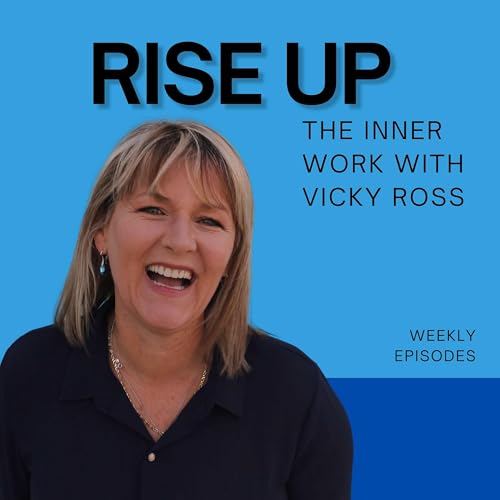
    Rise Up is a podcast about personal growth — with a sense of humour.

    Because life gets messy. We overthink. We over-give. We under-rest. We eat well… then we don’t. We move… then we stop. And before we know it, stress stops being something we feel and starts feeling like who we are.

    I’m Vicky Ross, and for over 30 years I’ve worked with intelligent, capable, self-aware people who aren’t broken — they’re just rehearsing the same internal conversations on repeat. And the brain doesn’t care whether a thought is helpful or harmful. It only notices what you practise.

    This podcast isn’t about fixing you.
    It’s about helping you notice what you’re doing without realising you’re doing it.

    Using neuroscience, language patterns, and my AIR Method — Awareness, Interruption, Rewiring — each episode offers short reflections and conversations that loosen old patterns and make change inevitable, not forced. Because once you see a pattern clearly, it starts to lose its grip. And once you can smile at it — or even laugh at it — it stops running the show.

    Some episodes will be gentle.
    Some might poke a little.
    All of them are here to help you live with more clarity, choice, and ease — without turning life into another self-improvement project.

    If you’re ready to live a little lighter, a little deeper, and stop taking every thought quite so seriously, you’re in the right place.

    Subscribe, come back often, and let this be a pause in your week — a moment of awareness that might change more than you think.

    Let’s rise up, one aware moment at a time.

    Show More Show Less
    7 mins