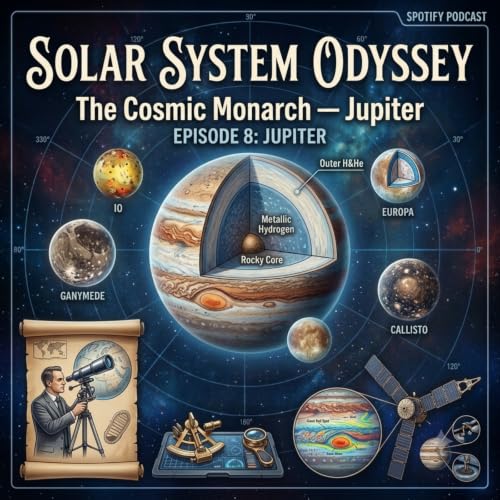
Solar System Odyssey cover art

Solar System Odyssey

Solar System Odyssey

Written by: Deep Mudi
Listen for free

Solar System Odyssey | A Fall in Cosmos Podcast Series

Eight planets. Over 200 moons. Countless asteroids, comets, and dwarf worlds — all orbiting one star, all part of a story that began 4.6 billion years ago in a collapsing cloud of dust. Solar System Odyssey is a deep-dive podcast series that takes you, world by world, through every corner of our cosmic neighborhood — not as a checklist of facts, but as the greatest road trip in existence.

Every episode has one destination. Mercury, scarred and sun-scorched. Venus, a greenhouse hell hiding under golden clouds. Mars, the red world we're racing to reach. Jupiter, a failed star holding a moon with an ocean beneath its ice. Saturn, wearing rings made of a trillion pieces of shattered ice. Uranus, tilted on its side like a rolling barrel. Neptune, howling with the fastest winds in the solar system. And the dwarf worlds and comets at the edge — Pluto, Ceres, and the icy wanderers of the Oort Cloud, whispering messages from the birth of everything.

Socho — think about it. Every rock, every moon, every ring you'll hear about in this series is made of the same atoms sitting in your own body right now. We didn't just study the solar system. We are the solar system, looking back at itself.

Each deep dive blends hard planetary science — orbital mechanics, atmospheric chemistry, geology, the latest data from NASA, ESA, and ISRO missions — with the physical pictures that make it click. Think of Saturn's rings as a symphony of ice conducted by gravity. Think of a black hole not as a monster, but as a mathematical inevitability written into spacetime itself. Bingo — that's the moment abstract physics turns into something you can actually feel.

Not so fast, though — this series doesn't shy away from the mysteries science hasn't solved yet: why Venus spins backward, what's really under Europa's ice, why Uranus is tipped completely on its side. The unanswered questions are just as much a part of the odyssey as the answered ones.

Long before space telescopes, ancient civilizations across the world — Babylonian astronomers, Egyptian priests, Mayan calendar-keepers, Greek philosophers — looked at these same wandering lights in the sky and built entire mythologies, calendars, and worldviews around them. Solar System Odyssey connects that ancient wonder directly to modern exploration — from Galileo's first telescope pointed at Jupiter's moons to the Parker Solar Probe grazing the sun, to rovers driving across Martian dust right now.

On the Kardashev Scale, true mastery of a solar system belongs to a Type II civilization. We're still a fragile Type 0.7, clinging to one planet — but every mission, every discovery in this series, is a small step toward reading the mind of God in the mechanics of our own cosmic backyard.

This isn't just a tour of planets. It's a series about scale, humility, and wonder — about realizing that every world out there is a mirror, showing us something new about the one we call home.

🎧 New deep-dive episodes exploring one solar system object at a time. Subscribe to Fall in Cosmos and journey through the solar system with us — one world at a time.

Astronomy & Space Science Physics Science
Episodes
  • Saturn: Crown Jewel of Our Solar System
    Sep 24 2026

    Hey! I'd love to hear your thoughts, send me a voice note.

    Saturn: Crown Jewel of Our Solar System | Solar System Odyssey

    Eight worlds behind us, and now we reach the one every telescope points at first — not because it's the biggest, not because it's the most violent, but because nothing else in the sky looks quite so deliberately beautiful. Saturn wears rings made of a trillion pieces of ice and rock, some no larger than a grain of sand, others the size of a house, all held in place by nothing but physics and patience.

    Imagine a planet so light it would actually float if you dropped it into a bathtub large enough to hold it — Saturn's density is lower than water, the only planet in the solar system that can make that claim. And yet this same "lightweight" world commands a ring system spanning nearly 175,000 miles across, while standing barely a kilometer thick in most places. Scale like that shouldn't make sense. It does anyway.

    Socho — think about it. Those rings aren't ancient leftovers from the solar system's birth, the way we once assumed. Data from the Cassini mission suggests they may be far younger, possibly just 100 million years old — meaning dinosaurs walked the Earth in a solar system where Saturn had no rings at all. What you're picturing when you picture Saturn might be one of the newest features in this entire odyssey, not one of the oldest.

    Saturn doesn't just wear beauty — it hides violence and mystery in equal measure. Winds in its atmosphere reach 1,800 kilometers per hour, and a perfectly hexagonal jet stream churns at its north pole, a six-sided storm pattern that shouldn't exist in nature, yet has persisted for decades. Bingo — sometimes the universe hands us geometry so precise it looks engineered, and it still isn't.

    Not so fast, though — Saturn's real treasures may not be the planet at all, but two of its 146 known moons. Titan, thick with an atmosphere denser than Earth's, holds rivers, lakes, and rain — not of water, but of liquid methane, the only other place in the solar system with stable liquid on its surface. Enceladus, smaller and icier, shoots geysers of water vapor from its south pole into space, hinting at a subsurface ocean that could, right now, hold the conditions for life. NASA's Cassini spacecraft spent 13 years orbiting this system before deliberately diving into Saturn's atmosphere in 2017, ending its mission by becoming part of the very planet it spent over a decade revealing to us.

    Ancient skywatchers saw Saturn without any of this, and still gave it the weight of an entire era — Babylonian astronomers associated it with their god of agriculture and time, Roman astronomers named it after the same, Saturn, father of Jupiter himself in their mythology, the god eventually overthrown by his own son, echoed strangely in the fact that Jupiter, the planet, is more massive than Saturn today. In 1610, Galileo saw something strange around Saturn but lacked the resolution to understand it — he described it as "ears," never realizing he'd become the first human to glimpse rings around another world.

    Here's the part worth sitting with: Saturn is proof that grandeur doesn't require density, violence, or mass to dominate a scene. Sometimes the most commanding presence in a room — or a solar system — is the one that simply understood elegance, and let that be enough. Read the mind of God, and here, you'll find it written in ice, light, and impossibly thin rings holding their shape across a hundred thousand miles.

    Researched and written by me. Voice and visuals produced with AI, so I can go deeper on every world in this series.

    🎧 Episode 9 of Solar System Odyssey — a Fall in Cosmos series. Subscribe, and let's fall in cosmos, together.

    Keywords: Saturn planet explained, Solar System Odyssey podcast, Saturn rings explained, Titan Enceladus moons, Cassini mission Saturn, Saturn hexagon storm, ringed planet facts, ancient astronomy Saturn.

    Show More Show Less
    23 mins
  • Jupiter: Cosmic Monarch of Our Solar System
    Sep 21 2026

    Hey! I'd love to hear your thoughts, send me a voice note.

    Jupiter: The Cosmic Monarch | Solar System Odyssey

    Seven worlds behind us, and now we reach the one that almost wasn't a planet at all. Jupiter isn't just the largest world in our solar system — it's more massive than every other planet combined, twice over. If it had gathered just a little more mass during formation, it might have ignited into a second, smaller sun. Instead, it became something almost as commanding: a king that never quite claimed the throne.

    Imagine a storm larger than Earth itself, raging continuously for at least 190 years, with winds tearing across it at 640 kilometers per hour — the Great Red Spot isn't weather in any sense we experience. It's a permanent scar of violence, older than most nations on this planet, still spinning.

    Think about it — every planet before this one, we could imagine standing on. Not this one. Jupiter has no true surface at all. Descend far enough and the atmosphere doesn't end, it just thickens into a churning ocean of metallic hydrogen, under pressure so extreme that hydrogen itself starts behaving like a liquid metal, generating the most powerful magnetic field of any planet in the solar system.

    Jupiter doesn't just dominate through size — it dominates through gravity itself. It's the reason the asteroid belt never finished becoming a planet, the reason countless comets have been flung out of the solar system entirely, and the reason others, like Shoemaker-Levy 9 in 1994, were pulled in and torn apart on impact, live, in front of our own telescopes. That's not a metaphor for power. That's power, demonstrated.

    And yet Jupiter's real treasures aren't the planet itself — they're the 95 known moons orbiting it. Europa, hiding a liquid ocean beneath its icy shell, possibly more water than every ocean on Earth combined. Io, the most volcanically active body in the entire solar system, its surface repainted by eruptions faster than any geologist can map it. This isn't a planet. It's practically a solar system of its own, held in orbit around one dominant king.

    Here's what science still hasn't fully answered: what's actually happening at Jupiter's core. Does it even have a solid core at all, or does rock dissolve into that metallic hydrogen ocean entirely? NASA's Juno mission has been diving closer to Jupiter than any spacecraft before it specifically to find out — and every pass sends back data that complicates the picture further, rather than simplifying it.

    Ancient skywatchers had no telescopes, no way to see the storms or moons — yet they still recognized something commanding in that steady, bright wanderer. Babylonian astronomers associated it with their king of gods, Marduk. Roman astronomers named it after the king of their own pantheon, Jupiter — a name that's outlasted the empire that gave it. And in 1610, Galileo pointed a primitive telescope at it and discovered four moons orbiting another world for the first time in human history — a single observation that helped dismantle the idea that everything in the universe circled Earth.

    Here's the part worth sitting with: Jupiter never became a star, never had the mass to ignite. It spent 4.6 billion years as close to that threshold as any planet ever gets, and stayed a planet anyway. Sometimes the most powerful thing in a system isn't the one that burns brightest — it's the one whose gravity quietly shapes everything else without needing to.

    Researched and written by me. Voice and visuals produced with AI, so I can go deeper on every world in this series.

    🎧 Episode 8 of Solar System Odyssey — a Fall in Cosmos series. Subscribe, and let's fall in cosmos, together.

    Keywords: Jupiter planet explained, Solar System Odyssey podcast, Great Red Spot, Jupiter moons Europa Io, Juno mission NASA, largest planet solar system, Jupiter magnetic field, gas giant explained.

    Show More Show Less
    23 mins
  • The Asteroid Belt: The Untold Story of scattered Debris.
    Sep 18 2026

    Hey! I'd love to hear your thoughts, send me a voice note.

    The Asteroid Belt: The Untold Story of scattered Debris.

    Six worlds in, and we finally reach the gap — the wide, rubble-strewn stretch between Mars and Jupiter that most solar system tours skip past entirely, as if it's empty space between the "real" planets. It isn't empty. It's a graveyard, a nursery, and an untold origin story, all scattered across millions of fragments no one bothered to name.

    Imagine a region containing over a million known asteroids, ranging from house-sized boulders to Ceres, a dwarf planet large enough to be round under its own gravity — and yet, if you gathered every single object in the entire belt together, it would still add up to less than 4% of the mass of our own Moon. This isn't a destroyed planet, despite what science fiction loves to claim. It's a planet that never got the chance to form at all.

    Socho — think about it. Every asteroid out there is a fossil, a piece of the original disk of dust and gas that built Mercury, Venus, Earth, and Mars, except frozen in its unfinished state — because Jupiter's gravity kept stirring the region too violently for these fragments to ever come together into a world.

    The belt isn't as crowded as movies make it look, but it isn't gentle either. Vesta carries a crater so massive it blasted off enough material to seed a whole family of meteorites that have landed on Earth. Ceres hides bright salt deposits and possibly a subsurface layer of brine, making it one of the more surprising ocean-world candidates in the entire solar system. Bingo — a "leftover" region turning out to hold some of the most chemically interesting real estate we've found.

    Not so fast, though — the asteroid belt still holds an uncomfortable, active mystery: which of these fragments are on a path that eventually crosses Earth's orbit. NASA's DART mission already proved in 2022 that we can physically alter an asteroid's trajectory by slamming a spacecraft into it — turning the ancient threat of impact into, for the first time in our species' history, a problem with an actual engineering solution.

    Ancient skywatchers had no idea this belt existed — the first asteroid, Ceres, wasn't even discovered until 1801, by Giuseppe Piazzi, initially mistaken for a new planet entirely. But the deeper irony is older: astronomers for centuries assumed there simply had to be a "missing planet" in that gap, following the neat mathematical pattern of planetary spacing known as the Titius-Bode law — and in a strange way, they were right that something belonged there. It just never finished becoming one.

    Here's the part worth sitting with: the asteroid belt is proof that not every beginning gets to become something whole — and that "unfinished" doesn't mean "meaningless." These fragments carry the rawest, least-altered material from the solar system's birth, more chemically pristine in some ways than the planets that succeeded. Sometimes the untold stories carry the oldest truths. Read the mind of God, and here, you'll find it written in rubble, not in worlds.

    The asteroid belt isn't a gap between planets. It's the origin story none of the planets got to finish telling.

    🎧 Episode 7 of Solar System Odyssey — a Fall in Cosmos series. Subscribe to journey through the solar system, one world at a time.

    Keywords: asteroid belt explained, Solar System Odyssey podcast, Ceres dwarf planet, Vesta asteroid, DART mission NASA, asteroid impact threat, Titius-Bode law, planetary science podcast, astronomy podcast series, space exploration podcast, history of asteroid discovery, near Earth asteroids, astrophysics for beginners, science and philosophy podcast, planetary geology podcast

    Show More Show Less
    22 mins
adbl_web_anon_alc_button_suppression_t1
No reviews yet