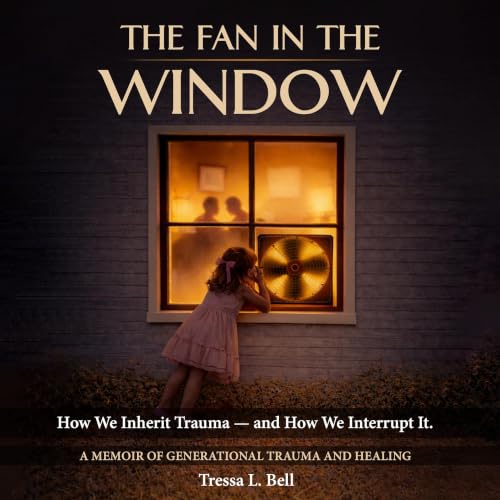
The Fan in the Window: Interrupting What We Inherit cover art

The Fan in the Window: Interrupting What We Inherit

The Fan in the Window: Interrupting What We Inherit

Written by: Tressa L. Bell MBA BSN RN
Listen for free

The Fan in the Window: Interrupting What We Inherit explores trauma, nervous systems, and the patterns we carry into our relationships. Join Tressa L. Bell—registered nurse, former forensic nurse examiner, author, and survivor—for honest conversations about generational trauma, intimate partner violence, parenting, and relationship safety. Through personal stories and clinical insight, we explore why familiar doesn’t always mean safe and how we can interrupt what we pass on. This didn’t start with you…but you can interrupt it. New episodes every other Tuesday.Tressa L. Bell, MBA, BSN, RN Relationships Social Sciences
Episodes
  • Daddy Issues and Mommy Issues: How Childhood Relationships Affect Adult Love
    Oct 6 2026

    “Daddy issues.” “Mommy issues.”


    People use those phrases as if they explain someone. They rarely picture the child standing at the door, waiting for a parent to say, “I love you,” back.


    In this solo episode of The Fan in the Window: InterruptingWhat We Inherit, Tressa Bell explores how childhood relationships can shape adult love, conflict, approval-seeking, and the way we respond to someone else’s disappointment.


    Drawing from her experiences with her biological and adoptive fathers, Tressa talks about loving a parent who also hurt you, why finding an absent parent doesn’t automatically create a sense of belonging, and how fear of spanking taught her to hide things rather than feel safe telling the truth.


    She also shares experiences her daughters have given herpermission to discuss—and considers what accountability asks of us when our own children tell us something we don’t want to hear.


    The conversation includes research on physical punishment,parental warmth, and recovery after relationship conflict, along with a practical example of the Interruption Model™: Notice, Name, Regulate, Interrupt, Repair, Repeat.


    In this episode: A painful childhood does not make you responsible for someone else’s abuse. And understanding your history doesn’t remove your responsibility for how you treat others now.


    A question to sit with

    When someone important to me seems disappointed or distant, what do I feel I have to do to keep the relationship okay?


    Free Audible codes

    The Fan in the Window memoir is available on Audible,narrated by Tressa. A limited number of free promotional codes are available while supplies last.

    Email tressa@thefaninthewindow.com to request a code.


    Books and a place to begin

    Find both books on Tressa’s Amazon author page:

    Get The First Interruption, a free starter kit and email series to help you recognize your patterns and begin practicing a different response.


    Research discussed

    Heilmann, A., et al. (2021). Physical punishmentand child outcomes: A narrative review of prospective studies. The Lancet, 398, 355–364.

    Lee, S. J., Altschul, I., & Gershoff, E. T. (2013). Does warmth moderate longitudinal associations between maternal spanking and child aggression in early childhood?Developmental Psychology, 49, 2017–2028.

    Salvatore, J. E., et al. (2011). Recovering from conflict inromantic relationships: A developmental perspective. Psychological Science, 22, 376–383.


    Content note and support

    This episode discusses childhood wounds, parental rejection,and physical punishment. It includes a brief, optional grounding practice. Please listen at your own pace.


    This podcast provides education and personal reflection. Itis not therapy, medical advice, or psychological treatment.

    In the U.S., call or text 988 for free, confidential support, available 24/7 through the 988 Suicide & Crisis Lifeline. Outside the U.S., find support at findahelpline.com.


    New episodes every other Tuesday. Follow the show wherever you listen, and visit thefaninthewindow.com to stay connected.


    This didn’t start with you…but you can interrupt it.

    Show More Show Less
    40 mins
  • What Happened To You?
    Sep 22 2026

    There is a question that changed the way I think aboutchildren.

    Not, what’s wrong with you?

    What happened to you?

    Those are two very different questions. And the one you askdetermines everything—what you see, what you miss, what you do next, and what the child in front of you learns about whether they are worth understanding.

    Today’s guest works with children and families every singleday inside a school building in Frederick, Maryland—where she sees what trauma actually looks like in the hallways, the classrooms, and the counselor’s office. This conversation is for every parent who has ever wondered what is really going on with their child. And for every adult who was once that child.


    IN THIS EPISODE

    — What it means clinically when trauma is stored in the body—and what the ACEs research tells us about its long-term impact

    — What a dysregulated nervous system looks like in someone who doesn’t know they have one

    — Why understanding a pattern isn’t enough to change it—and what neuroplasticity actually means for healing

    — What progress in trauma work really looks like, and why it’s so easy to miss

    — What’s actually underneath the child labeled difficult, defiant, or checked out

    — Why parents are often harder to reach than children—and what finally gets through

    — What school social workers can actually do for your family—IEPs, 504s, in-school therapy, and more

    — “Children don’t need a perfect parent. They need a presence that feels reliable and supportive.”


    CONTENT NOTE

    This episode discusses childhood trauma, adverse childhoodexperiences, behavioral presentations at school, and the impact of family dynamics on children’s mental health. Please listen at your own pace. In the U.S., call or text 988—free, confidential, 24/7. Outside the U.S.: findahelpline.com. You do not have to navigate this alone.


    FIND CAROLINE

    malamantiscounseling.com

    LinkedIn: Caroline Kinna Caroline Kinna | LinkedIn


    GET THE BOOKS

    The Fan in the Window: How We Inherit Trauma—And How WeInterrupt It and You Can Interrupt It: A Practical Guide for the Parent Who Inherited Trauma and Swore They’d Do It Differently are both available now on Amazon. If the memoir gave you the story, the companion book gives you theroadmap—built around the Interruption Model™, practical tools for doing the work one pattern at a time.

    amazon.com/author/tressalbell


    FOLLOW TRESSA

    thefaninthewindow.com/podcast

    Instagram, Facebook, TikTok, YouTube: @tressalbell

    Substack: tressalbell.substack.com

    LinkedIn: linkedin.com/in/tressa-l-bell-31830440a

    If this episode resonated, please leave a review on ApplePodcasts—it takes less than two minutes and helps new listeners find this work.

    This didn’t start with you…but you can interrupt it.

    Show More Show Less
    32 mins
  • What Familiar Feels Like
    Sep 8 2026

    Have you ever looked at a relationship and thought—how did Iend up here again?

    Not the same person. But the same feeling. The same dynamic. The same patterns playing out in a slightly different set of circumstances.

    You were not choosing wrong. Your nervous system was choosing familiar. And familiar and safe are not the same thing—but they feel that way when you grew up in a house where familiar meant surviving.

    This episode is about attachment. What it is, where it comes from, how it shapes every relationship you walk into as an adult—and what it means that you can interrupt it.


    IN THIS EPISODE

    — The four attachment styles: secure, anxious, avoidant, and disorganized—what each one looks like and where it comes from

    — The protest polka: why anxious and avoidant partners find each other and what happens between them

    — How the opposite-sex parent shapes a child’s template for romantic love

    — Why your parents weren’t the only ones who shaped your attachment—and what it meant when someone else was in the room

    — How attachment travels into parenting—and what that means for the children watching you now

    — Earned security: why you don’t have to have had a secure childhood to become a securely attached adult

    — The free attachment style quiz at thefaninthewindow.com/attachment-style-quiz


    CONTENT NOTE

    This episode discusses childhood trauma, sexual abuse, volatile caregiving environments, and how early relational experiences shape adult attachment. Please listen at your own pace.

    In the U.S., call or text 988—free, confidential, 24/7. Outside the U.S.: findahelpline.com. You do not have to navigate this alone.


    TAKE THE QUIZ

    Free attachment style quiz—solo or with a partner:

    thefaninthewindow.com/attachment-style-quiz


    GET THE BOOKS

    The Fan in the Window: How We Inherit Trauma—And How WeInterrupt It and You Can Interrupt It: A Practical Guide for the Parent Who Inherited Trauma and Swore They’d Do It Differently are both available now on Amazon. If the memoir gave you the story, the companion book gives you theroadmap—built around the Interruption Model™, practical tools for doing the work one pattern at a time.

    amazon.com/author/tressalbell


    FOLLOW TRESSA

    thefaninthewindow.com/podcast

    Instagram, Facebook, TikTok, YouTube: @tressalbell

    Substack: tressalbell.substack.com

    LinkedIn: linkedin.com/in/tressa-l-bell-31830440a

    If this episode resonated, please leave a review on ApplePodcasts—it takes less than two minutes and helps new listeners find this work.


    This didn’t start with you…but you can interrupt it.

    Show More Show Less
    27 mins
adbl_web_anon_alc_button_suppression_t1
No reviews yet