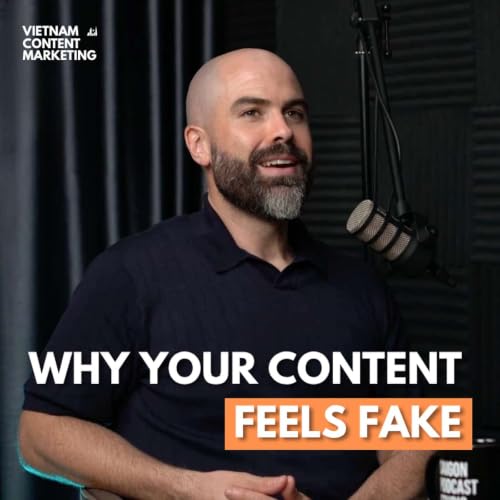
• Transcreate, Don’t Translate: How Brands Win Trust in Vietnam - Victor
    Nov 16 2026

    “Understanding before you speak is a great starting place.”

    Victor, a branding specialist who helps international brands enter Vietnam, explains why trust matters more than views, why Gen Z can spot a hidden sales pitch, and what Vietnamese audiences want from brands.

    We cover TikTok Shop, a viral April Fools campaign that backfired, why you should transcreate rather than translate, how to handle pricing and market fit, when to outsource content, and which platforms matter in Vietnam in 2026.

    Key takeaways

    1. Speak to your audience before you speak at them. Talk to people, test internally and check the local numbers before you launch.

    2. Be honest about what you’re selling. Vietnamese audiences value transparency. Hidden selling breaks trust, especially with Gen Z.

    3. Podcasts are for messaging first, sales second. People buy from people they know, like and trust, but nobody wants a friend who pitches them.

    4. Don’t treat a new market with levity you haven’t earned. A prank campaign went viral in Vietnam for the wrong reasons and was seen as arrogant.

    5. Transcreate, don’t translate. Adapt the offer and message to what the local audience values, not what you value.

    Timestamps and chapters

    01:00 - Gen Z, trust and the “BS detector”
    Why views don’t equal sales, and why hidden selling breaks trust.

    04:00 - Using a podcast to build trust, not make a pitch
    Messaging first, sales second, and why friends don’t sell to friends.

    11:00 - Transcreate, don’t translate
    The sand-in-Dubai example, adapting offers and brand voice, and a client case study.

    16:00 - Swallowing your pride: pricing and market fit
    Adapting your offer to the local market, and how the studio responded.

    28:00 - Facebook, Threads, LinkedIn and the role of podcasts
    Where to be in Vietnam in 2026, and why podcasts build trust fast.

    Show More Show Less
    33 mins
  • How to Get Media Coverage in Vietnam: What Journalists Actually Want
    Nov 2 2026

    “Be useful before trying to be visible.”

    Dr. Clara Lele, a PR practitioner, academic and agency founder, explains the difference between being seen and being trusted. We cover how to build a simple content system for a lean business, how much time a founder should spend on content, and why PR gives you third-party validation that posting daily never will.

    Clara also shares how to earn media coverage without paying for advertorials, how podcasts and traditional media build different kinds of authority, and why international brands confuse translation with localization in Vietnam.

    Key takeaways

    1. Be useful before you try to be visible. Start with the 10 questions your customers ask most often. Those are your first 10 pieces of content.

    2. Stop asking “what should we post today?” Ask what you know that people outside your business don’t. Then follow the loop: listen, create, post, evaluate, learn, repeat.

    3. Founders bring the brain, not the heavy lifting. One 30 to 45 minute session per week on the hardest question in your industry can fuel a whole content system. Let your team handle the rest. This is a lesson I’m still learning myself.

    4. Visibility and credibility are different things. You can buy visibility, but credibility needs third-party validation like media interviews, conferences and awards.

    5. Earn coverage by being useful to the journalist’s audience. Don’t ask them to write about your company. Offer unique insight, be concise and accurate, and don’t send a five-page company profile.

    6. Translation is not localization. Translation is how you say it in Vietnamese. Localization is how Vietnamese people understand it. This connects directly to my conversation with Mai Le about why foreign brands struggle here.

    7. Pitch the right podcast, and be a guest with something to say. Appearing on 20 podcasts a week won’t make you an authority if you have nothing useful to contribute.

    Timestamps and chapters

    • 01:00 - Building a simple, sustainable content system
    • 05:00 - Content marketing vs. PR
    • 14:00 - Getting media coverage without paying for advertorials
    • 21:00 - Translation vs. localization
    • 25:00 - Hanoi vs. Saigon audiences
    • 27:00 - Podcasting in Vietnam
    Show More Show Less
    30 mins
  • Trust Takes Time: Marketing Lessons from the Classroom and the Stock Exchange
    Oct 20 2026

    “Keep it simple, not oversimplified.”

    My guest this time is Mai. She teaches marketing to undergraduates in Saigon, judged the Vietnam Innovation Challenge, and previously worked in corporate communications at the Ho Chi Minh Stock Exchange.

    We talk about what young marketers get right and wrong, why AI can’t replace real-world experience, why brands like Baskin Robbins and Subway struggled in Vietnam, and how to build trust through consistent content. We also get into why a pho burger might not be a great idea.

    5 Key Takeaways

    1. AI gives structured answers, but real life doesn’t work that way. Mai tells her students to visit branches, mystery-shop competitors, and experience the service as a customer.

    2. Don’t generalize about “young consumers.” Saying “young people are price sensitive” means nothing without segmentation: which people, from where, and what do you mean by price sensitive?

    3. Foreign brands fail when they copy-paste their home playbook. Imported ingredients push prices too high, local competitors offer cheaper options with local taste, and Vietnamese consumers have plenty of choice.

    4. Trust comes from consistency, and it takes time. Students trust Mai because of two things: what past students say about her (borrowed trust) and the value she delivers herself (own trust). The same applies to podcasts. Plan for the long term.

    5. Trust dies when the promise doesn’t match the experience. Great reviews and word of mouth mean nothing if the next customer doesn’t get the same value. Care before, during, and after the sale.

    Chapters and Timestamp:

    00:00 – The best and worst advice

    02:00 – Young vs. experienced marketers, and the limits of AI

    13:00 – Why foreign brands struggle in Vietnam

    21:00 – Communicating at the Ho Chi Minh Stock Exchange

    27:00 – Building and losing trust

    Show More Show Less
    39 mins
  • Why Short-Form Content Isn't Enough (And What's Missing From It)
    Aug 20 2026

    "The long form is necessary in order to get the full scope of everything, and the clip should feed curiosity enough to get the person to engage with the long form."

    That's Carey, and it's the exact line that sparked this whole episode for me.

    In this conversation, Carey and I got into why everything in media feels like it's "on fire" right now — constant tension, constant urgency — and why that pressure pushes so many creators toward short-form content without thinking about what it's actually for. We talked about what gets lost when clips try to stand alone, why a clip's real job is to spark curiosity instead of satisfy it, and how to actually build a bridge between your short-form content and your long-form work.

    Carey also joined me here at Saigon Podcast Studio as part of the VPW crew for another episode of Outside the Ring — so there's a bit of a fun studio moment in here too.

    5 Key Takeaways

    1. Media is built on manufactured tension. Nothing feels calm anymore — everything is framed as urgent or dramatic, and that pressure shapes how creators think about content.
    2. Short-form content can't carry the full story. A clip can spark a reaction, but it doesn't have room for context, nuance, or the reasoning behind an idea.
    3. A clip's job is to raise a question, not answer one. Clips that feel "complete" give people no reason to seek out more.
    4. Long-form content is where trust actually gets built. It's the only format with enough room to explain the "why" behind the "what."
    5. The best content strategy connects both formats. Short-form content should function as a doorway to long-form — not a replacement for it.

    5 Chapters

    • [00:00] Intro — Why Everything Feels Like It's On Fire
    • [06:15] The Trap of Chasing Short-Form Content
    • [13:40] What Gets Lost Without Long-Form
    • [21:05] Clips Should Spark Curiosity, Not Satisfy It
    • [25:30] Wrap-Up — Welcoming Outside the Ring to the Studio
    Show More Show Less
    27 mins
  • Why Perfection Hurts Your Personal Brand (And What to Share Instead)
    Aug 14 2026

    "They identify with limits and how you can deal with limits to have success."

    That's Francesca, and it's honestly the line from this conversation that I haven't stopped thinking about.

    We got into why showing only your wins causes engagement to quietly die off, why sounding too polished on a podcast can actually push listeners away, and why sharing your limits — not hiding them — is what makes people stick around.

    If you've ever wondered why your best content isn't getting the traction you expected, this one's for you.

    5 Key Takeaways

    1. Success alone doesn't hold attention. Posts that only show wins tend to fade fast — Francesca described watching likes drop from 30, to 20, to 10, until only close friends and family were left engaging.
    2. People connect with limits, not achievements. Audiences don't relate to your highlight reel — they relate to how you handle the hard parts.
    3. Perfection can alienate your audience. A podcast host who sounds flawless can unintentionally make listeners think, "I could never do that."
    4. Vulnerability builds trust faster than polish. Sharing a struggle — like recording in a non-native language — invites people in instead of shutting them out.
    5. This applies everywhere, not just podcasting. Social media, personal branding, business content — the same principle holds: show the process, not just the outcome.

    5 Chapters

    • [00:00] Intro — Why This Episode Hits Different
      I open the episode and introduce Francesca, setting up why we're talking about authenticity and the "perfection trap."
    • [05:30] The 30-20-10 Problem
      Francesca breaks down the pattern of posting only success — and why engagement quietly dies when there's nothing for people to relate to.
    • [12:15] The Podcast Host Who's "Too Perfect"
      We dig into her example of a flawless English-speaking host — and why that flawlessness can actually discourage listeners instead of inspiring them.
    • [19:40] Sharing the Limit, Not Just the Win
      Practical talk about what it actually looks like to share struggles without oversharing or manufacturing weakness for attention.
    • [27:50] Wrap-Up — What to Do With This
      We close out the conversation with final thoughts, and I thank Francesca for joining me on Vietnam Content Marketing.


    Show More Show Less
    36 mins
  • Mental Availability: Why Small Business Podcasts Beat Big Ad Budgets - with Dr. Neil Doyle
    Aug 6 2026
    "Marketing isn't about selling. It's about changing customer behavior."

    When most people think about marketing, they think about getting more leads, more clicks, or more sales. But in this episode, Dr. Neil Doyle challenged me to think about marketing in a completely different way.

    Instead of chasing vanity metrics, Neil argues that great marketing starts with understanding your customer, building mental availability, and influencing behaviour long before someone is ready to buy.

    This episode completely changed the way I think about content strategy, and I think it'll do the same for you.

    Key Takeaways

    • Why changing behavior—not selling—is the true goal of marketing.
    • The importance of building mental availability before customers are ready to buy.
    • How emotion influences almost every purchasing decision.
    • A simple behavioral science principle every marketer should use: loss aversion.
    • How AI search is changing SEO and content marketing.
    • Why transcripts and thought leadership are becoming more important than ever.
    • How podcasts help niche B2B companies stay top of mind.

    Chapters

    00:00 Quick-fire questions: the best and worst marketing advice

    03:00 What brand building actually means

    06:00 Does a brand reflect the founder?

    12:00 Why customers care about outcomes—not your equipment or features

    13:30 AI search and the future of content marketing

    19:00 Using podcasts to nurture relationships and stay top of mind

    21:00 Why strategy should always come before content


    Show More Show Less
    28 mins
  • The One Content Metric That Actually Predicts Sales - 6 Lessons from Stevie Parcalidis
    Jul 30 2026

    "Going viral is like winning the lottery. Creating consistent content is like investing in your future."

    Most business owners think content marketing is about getting more views, more likes, or hopefully going viral. But as Stephen Parcalidis explains in this episode, that's the wrong metric to focus on.

    Stephen is the founder of Worldtrip Media, a content marketing agency in Vietnam, and someone who has spent years helping businesses turn content into actual customers.

    We explored why podcasts have become one of the most powerful tools for building trust. As someone who has just launched his own show, The DAMN Thing, Stevie shares why he believes long-form conversations create authority in a way that short-form content simply can't.

    If you've ever wondered whether your content is actually helping your business—or whether starting a podcast is worth the effort—this conversation is packed with practical advice you can apply immediately.

    Key Takeaways

    • Why going viral shouldn't be your content strategy.
    • The difference between content that looks good and content that generates customers.
    • The biggest branding mistake businesses make before running ads.
    • The importance of repurposing one podcast into dozens of content pieces.
    • Practical advice for becoming more confident on camera.
    • Why your first podcast doesn't need to be perfect—it just needs to exist.

    Chapters

    02:00 Why beautiful content often fails to generate customers

    04:00 The biggest mistake businesses make with branding and advertising

    07:40 Repurposing podcast content for maximum reach

    12:00 The hidden work behind producing a podcast

    15:00 Why you should just record your first episode

    16:00 Final thoughts and advice for business owners

    Show More Show Less
    22 mins
  • How to Create Viral Content Without Chasing Virality | Lessons from Anii Hoang
    Jul 23 2026

    "Podcasting is the easiest way to produce content because you are not the expert in that conversation, but you are the one hosting it." – Anii Hoang

    Anii is the host of The Aspiring CMO Podcast and a content marketer who has built her career by consistently creating content, learning from data, and never being afraid to experiment. She shared how starting a podcast before she was an experienced marketer helped her build a personal brand, expand her network, and open doors that a CV alone never could.

    One of my biggest takeaways was that great content marketers aren't obsessed with going viral—they're obsessed with getting a little better every time they publish. They study what works, learn from the numbers, and keep improving. That mindset reminded me of something we live by at Seven Million Bikes Podcasts and Saigon Podcast Studio: improve by just 1% every day.

    Key Takeaways:

    • Why starting a podcast can accelerate your career and build your personal brand.
    • The habits and mindset that separate great content marketers from average ones.
    • Why consistency, data, and constant improvement matter more than chasing viral content.
    • Common mistakes businesses make before they even start creating content.
    • How podcasting has evolved and why having a unique concept is more important than ever.

    Timestamps

    00:00 – Rapid-fire content marketing advice and Anii's journey into podcasting

    02:00 – How The Aspiring CMO Podcast helped build her personal brand and career

    06:00 – What separates great content marketers from everyone else

    10:00 – The importance of retention, better content, and why shorter often wins

    13:00 – Why great marketing starts with a great product, not great content

    16:00 – Chasing virality, controversy, and setting the right boundaries for brands

    20:30 – The future of podcasting and why every new show needs a memorable concept

    Show More Show Less
    29 mins